

03-05-2026
At What Weight Is a 2290 Required for Trucks?


If you are wondering at what weight is a 2290 required, the IRS rule is straightforward, but the real-world details (registered weight, trailers, and IRP renewals) are where fleets and owner-operators often get tripped up.
The practical takeaway: if your truck’s taxable gross weight is 55,000 pounds or more and it’s used on public highways, you generally need to file IRS Form 2290 (HVUT) and obtain your Form 2290 Schedule 1 as proof of filing and payment.
The short answer: the 55,000-pound threshold
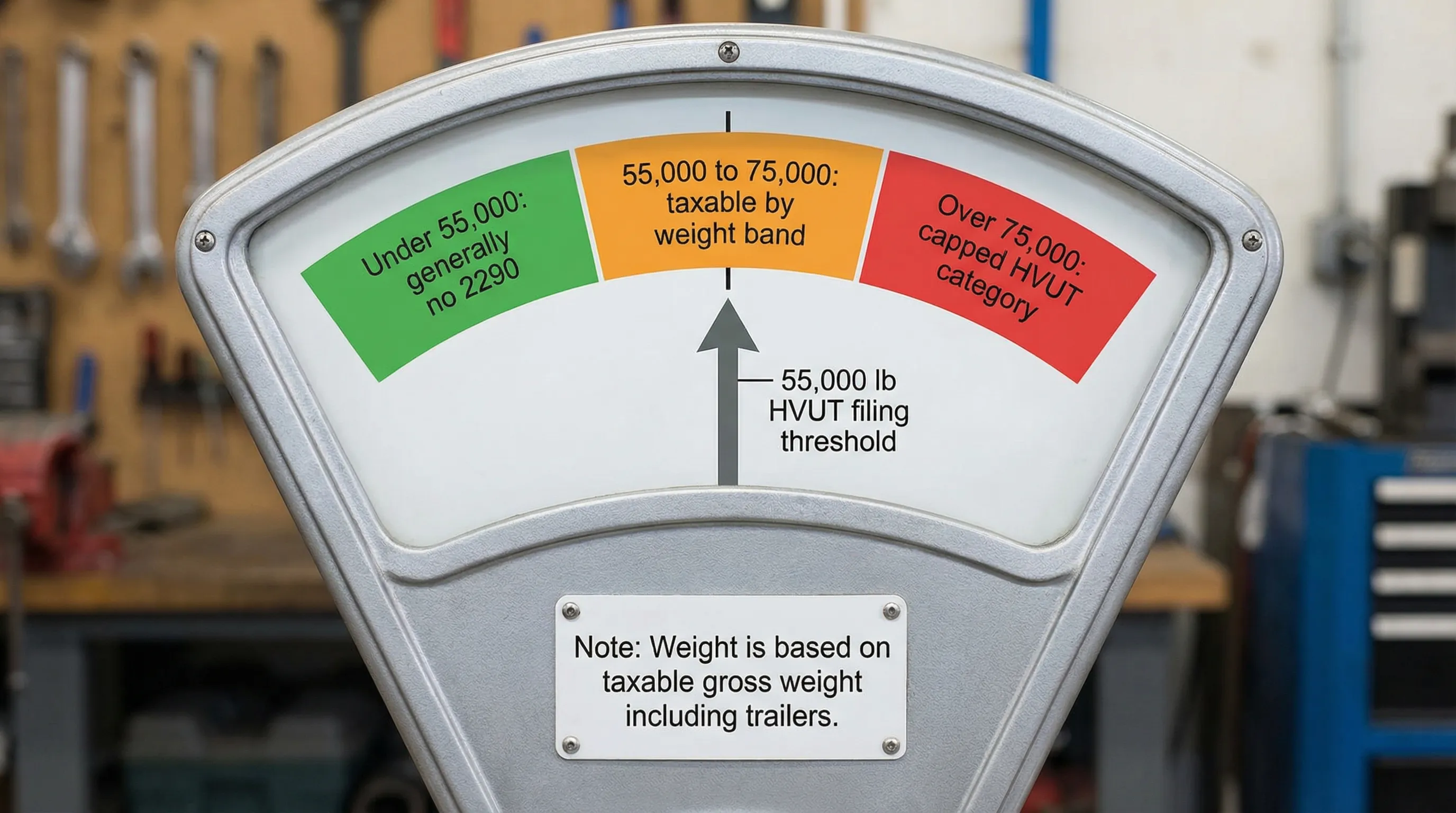
Form 2290 is required when a highway motor vehicle has a taxable gross weight of 55,000 lbs or more. This is the key threshold most drivers remember, and it’s the right starting point.
The IRS uses 55,000 lbs because the Heavy Vehicle Use Tax (HVUT) is designed for heavier vehicles that have a higher impact on highway wear. With trucking moving roughly 72% of U.S. freight by tonnage (per the American Trucking Associations), HVUT compliance has become a routine operational requirement for most interstate carriers, not an occasional paperwork event.
“Taxable gross weight” is not always what people think it is
Many drivers assume weight means the number on a scale ticket. For Form 2290, taxable gross weight is a calculated, compliance-focused number based on how the vehicle is configured and registered for highway use.
According to the IRS Form 2290 instructions, taxable gross weight generally includes:
- The unloaded weight of the vehicle (fully equipped for service)
- The unloaded weight of any trailers customarily used with the vehicle
- The maximum load customarily carried on the vehicle and trailers
You can review the official rules in the IRS Form 2290 and instructions.
Rounding rule that affects borderline cases
The IRS calculation uses weight categories that are based on pounds rounded to the nearest 500 lbs. That sounds minor until you are sitting at the edge of 54,500 to 55,000 and trying to decide whether you file.
In practice, most carriers avoid “borderline” thinking and align their taxable weight to what they are actually registered to operate at. That is also what many DMVs and IRP offices expect to see.
A quick decision table: do you need Form 2290 based on weight?
Use this as a fast screening tool before you dig into your cab card, IRP paperwork, or registration weight.
| Scenario | Typical taxable gross weight | Is Form 2290 generally required? | What you will need for compliance |
|---|---|---|---|
| Light duty truck/box truck used commercially | Under 55,000 lbs | Usually no | Confirm registered weight and configuration |
| Heavy truck, tractor, or truck-trailer combo | 55,000 lbs or more | Yes | EIN, vehicle identification number (VIN), first used month, weight category |
| Vehicle expected to run low miles (suspended category) | 55,000 lbs or more | Yes (still filed, but may be suspended) | Form 2290 filed as suspended if under mileage limit |
| Weight increases mid-year | Crosses into a higher band | Yes (amendment) | Taxable Weight Amendments (additional HVUT due) |
Important nuance: “Generally” is doing work here because exemptions and special cases exist. Weight is the primary trigger, but it is not the only one.
The operational reality: Form 2290 and IRP registration are linked
For many carriers, the most painful “reminder” that HVUT is due is not the IRS. It’s the registration process.
Why IRP offices often ask for your stamped Schedule 1
Most states require proof of HVUT payment to issue or renew apportioned plates, especially for vehicles registered at 55,000 lbs or more. That proof is your IRS-stamped Form 2290 Schedule 1.
This is where the phrases truckers search for, like:
- 2290 Schedule 1 for IRP
- Form 2290 and IRP registration
- Form 2290 schedule 1
become very real. If you show up without a valid Schedule 1, your irp truck registration renewal can stall, which can stall dispatch, which can stall revenue.
Strategic lesson learned from fleets: many build HVUT filing into a repeatable “compliance sprint” ahead of peak registration season so they are not waiting on paperwork when they should be running loads.
Weight bands also affect how much you pay (and why accuracy matters)
Once you cross 55,000 lbs, the HVUT amount depends on your weight category. While you should always verify your exact tax with the current IRS tables, the widely used structure is:
- Under 55,000 lbs: typically no HVUT due
- 55,000 to 75,000 lbs: increases by weight band
- Over 75,000 lbs: typically capped at the maximum HVUT amount
You can confirm the exact numbers each tax year in IRS instructions for Form 2290.
Business impact: weight accuracy is a margin issue
This is not just “tax math.” It is operational cost control.
- If you understate weight, you risk IRS problems and DMV/IRP issues if the paperwork does not match your registered operating weight.
- If you overstate weight, you can end up overpaying HVUT, which becomes a direct margin hit, especially for small fleets.
A common real-world example from fleet managers: a truck that usually runs regional at a lower registered weight gets moved to heavier lanes later in the year. If the truck’s operating configuration changes and the registered taxable weight is increased, the correct move is typically a Taxable Weight Amendment on Form 2290.
When weight changes, you may need a 2290 amendment (not a full refile)
Weight increases happen all the time:
- You add a different trailer configuration.
- You change the loads you typically haul.
- You re-register at a higher operating weight for new contracts.
When a vehicle moves into a higher weight category during the tax period, you generally file a taxable gross weight increase amendment and pay the additional tax owed for the remaining months.
This is one reason an Easy 2290 workflow matters. The amendment itself is not conceptually hard, but it is easy to delay, and delayed amendments can cause the same problem as delayed annual filings (no acceptable Schedule 1 for your updated registration weight).
The “VIN and weight” pairing that prevents rejections
Most filing delays are not about the weight threshold itself. They happen because of data issues.
Two items must match your records exactly:
- Vehicle identification number (VIN)
- Taxable weight category (based on your filing basis and registration intent)
If you mistype a VIN, you can end up needing a correction before your Schedule 1 is usable for registration. The IRS-stamped Schedule 1 is only as good as the VIN printed on it.
Trend to watch in 2026: tighter turnaround expectations
HVUT rules are stable, but expectations are changing.
- IRP and DMV offices increasingly expect digital uploads of documents.
- Fleets are operating with leaner back offices and less time to fix rejected filings.
- Owner-operators are trying to minimize downtime in August and September (when many renewals hit).
That combination drives a simple strategic decision: file in a way that gives you fast confirmation and quick access to your Schedule 1.
Paper filing vs electronic filing: the time-value comparison
From a purely operational perspective, the difference is turnaround time and error recovery.
| Filing method | What carriers typically optimize for | Practical downside |
|---|---|---|
| Paper filing | Familiarity | Slower processing and slower corrections if something is wrong |
| E-file through an IRS Authorized E-file Provider | Speed, validation, faster Schedule 1 availability | Requires using an online platform and keeping login access |
If your next step after HVUT is IRP registration, speed matters because delays become non-revenue days.
How Simple Form 2290 fits into an “Easy 2290” compliance workflow
If your vehicle is at or above the threshold and you want to electronic file form 2290 and pay online, an IRS-authorized platform can reduce the two biggest pain points: (1) errors and (2) waiting.
Simple Form 2290 is an IRS Authorized E-file Provider designed for truckers and fleets that want a guided process and quick access to an IRS-stamped Schedule 1. Depending on your situation, features that tend to matter most are:
- Step-by-step filing flow (helpful for first-time filers)
- Bulk filings for fleets
- Secure access to prior returns and Schedule 1 retrieval
- Bilingual support (English/Spanish)
If you do need an IRS online account for other reasons (for example, some carriers use EFTPS and search “irs create account”), it is still worth knowing you do not need to build your compliance process around that step just to file Form 2290 through an authorized e-file provider.
Bottom line: at what weight is a 2290 required?
If your truck (or truck and trailer combination, based on taxable gross weight rules) is 55,000 pounds or more, Form 2290 is generally required, and your next goal should be obtaining your Form 2290 Schedule 1 in a format accepted for registration and IRP.
The “smart” strategy is not simply knowing the threshold. It’s building a repeatable workflow that:
- Uses the correct taxable weight category from the start
- Keeps VINs accurate to avoid rejected filings
- Handles weight changes promptly with amendments
- Produces Schedule 1 quickly so IRP and registration do not get delayed
When you are ready, you can file through Simple Form 2290 to keep the process streamlined and get your Schedule 1 promptly after IRS acceptance.
Our services are also available for E-File Florida Form 2290 Online, Form 2290 Texas, Form 2290 California, Form 2290 in Illinois, File Form 2290 in Georgia, File Form 2290 in Tennessee and File Form 2290 in Pennsylvania .