09-01-2026
California Vehicle Registration and Form 2290: What Truck Owners Need to Know


California Vehicle Registration for a heavy truck can stall if the federal HVUT paperwork is missing. If your truck or bus has a taxable gross weight of 55,000 lbs or more, the California DMV may ask for a stamped Schedule 1 from IRS Form 2290 before it completes registration or renewal. If you are close to a DMV visit and need proof fast, filing through the cheapest 2290 e file online option can help you get your Schedule 1 without waiting on paper mail.
For truck owners, this is where state rules and federal tax rules meet. The California DMV handles the state registration record, plates, renewals, transfers and registration cards. The IRS handles Form 2290, the federal heavy vehicle use tax return. California does not collect that federal tax, but it often requires proof that the tax was filed and accepted.
In plain English, if your heavy vehicle is used on public highways and meets the 55,000 lbs threshold, do not treat DMV renewal and Form 2290 as separate chores. They usually need to line up.
Does California Require Form 2290 for Heavy Vehicles?
Yes, for many heavy commercial vehicles. The short answer for Form 2290 California questions is yes if the vehicle is a truck, tractor, bus or similar heavy highway vehicle with a taxable gross weight of 55,000 lbs or more.
For California Vehicle Registration, the DMV is not asking you to pay a state version of HVUT. It is asking for proof that the federal heavy vehicle use tax was filed with the IRS. The proof is usually an IRS stamped or watermarked Schedule 1.
The California DMV Federal Heavy Vehicle Use Tax procedure explains that proof of payment is required for certain commercial vehicles and buses at or above the weight threshold. The DMV also checks the VIN and vehicle details. If the VIN on Schedule 1 does not match the vehicle record, your registration can be delayed.
This requirement commonly affects:
- Owner operators registering a qualifying truck in California
- Fleet owners renewing heavy vehicles with the DMV or IRP office
- Carriers moving trucks into California from another state
- Truck owners who bought a used heavy vehicle and need to transfer or renew registration
The state side is handled through the California DMV vehicle registration process, while the federal tax side is handled through IRS Form 2290.
What Is Form 2290 Schedule 1?
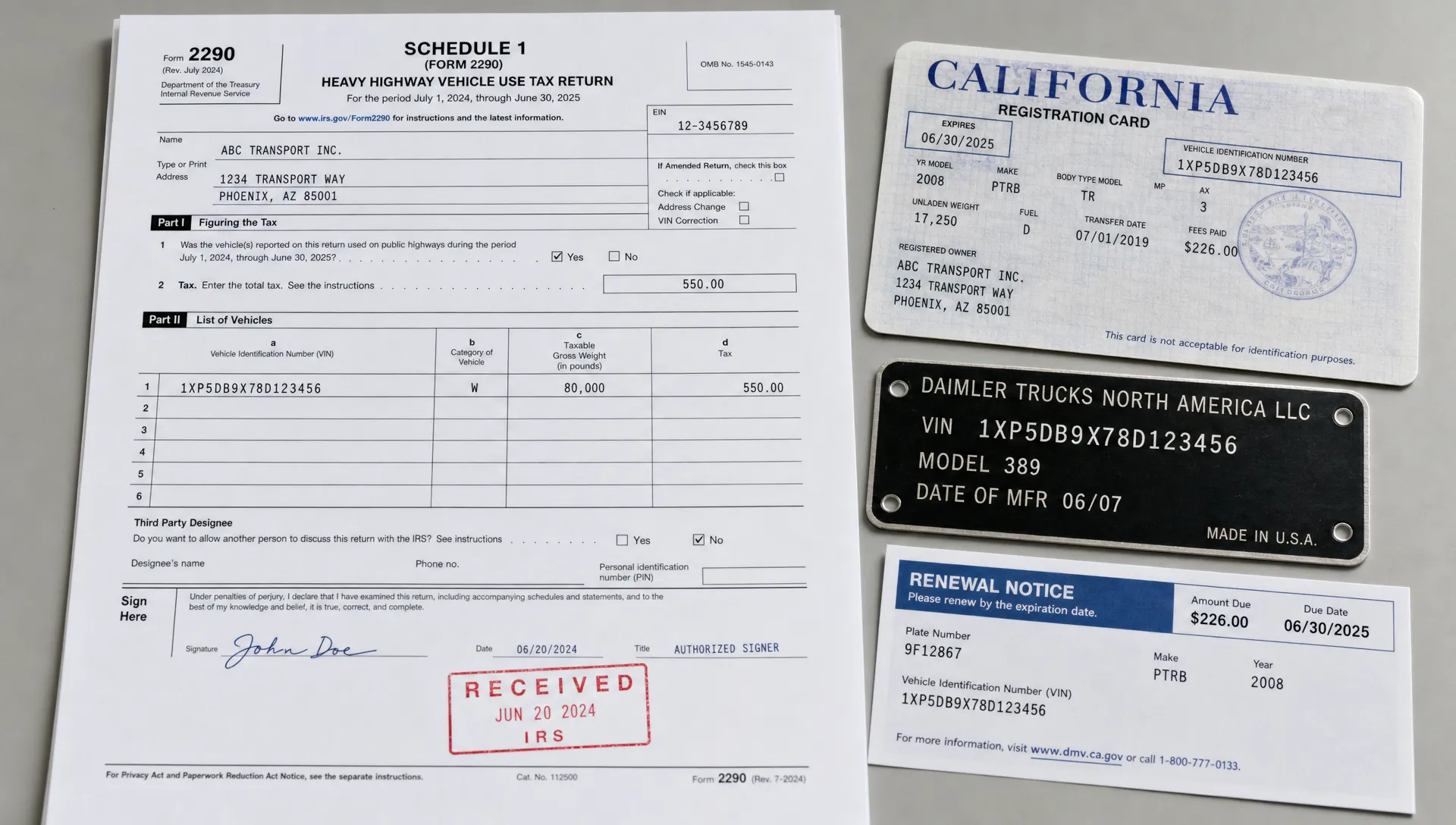
Form 2290 is the IRS heavy highway vehicle use tax return. Schedule 1 is the receipt page that proves the IRS accepted the return for the listed vehicles.
Think of Schedule 1 as the document the DMV actually wants to see. The full return shows how the tax was calculated. The stamped Schedule 1 shows that the IRS has accepted the vehicle information for that tax period. If you file electronically, the accepted Schedule 1 usually includes an IRS watermark.
A typical form 2290 Schedule 1 includes these details:
| Schedule 1 detail | Why it matters for California truck owners |
|---|---|
| Employer Identification Number | Identifies the business or owner filing with the IRS |
| Business name and address | Should match your filing records and DMV paperwork as closely as possible |
| Vehicle Identification Number | Must match the truck VIN used for DMV or IRP registration |
| Tax period | Shows the HVUT year covered by the filing |
| IRS stamp or watermark | Proves the IRS accepted the return |
The IRS tax period for Form 2290 runs from July 1 to June 30. For the 2026 filing season, vehicles first used in July 2026 generally need Form 2290 filed by August 31, 2026. If the vehicle is first used later in the tax year, the deadline changes based on the first use month.
The IRS explains the federal return on its About Form 2290 page. The tax itself is based on taxable gross weight. For non logging vehicles, it generally ranges from $100 to $550 per year, with the top rate applying at 75,000 lbs or more.
How Form 2290 Schedule 1 Is Used for California Vehicle Registration
For California Vehicle Registration, Schedule 1 acts as federal tax proof for qualifying heavy vehicles. It does not replace your title, insurance, California registration card or other DMV documents. It supports the DMV registration process when federal HVUT proof is required.
Here is how it usually comes into play:
| DMV situation | How Schedule 1 is used |
|---|---|
| Annual renewal for a heavy truck | The DMV may require the current stamped Schedule 1 before renewal is completed |
| Original California registration for a qualifying heavy vehicle | The DMV may ask for Schedule 1 along with title, ownership and insurance documents |
| IRP renewal | California IRP offices commonly require the most current Schedule 1 for apportioned heavy vehicles |
| VIN or ownership mismatch | Registration can be delayed until the VIN and ownership details are corrected |
Your vehicle registration card California drivers keep in the cab proves state registration. Schedule 1 proves federal HVUT compliance. They are not the same document, but for heavy vehicles they often work together.
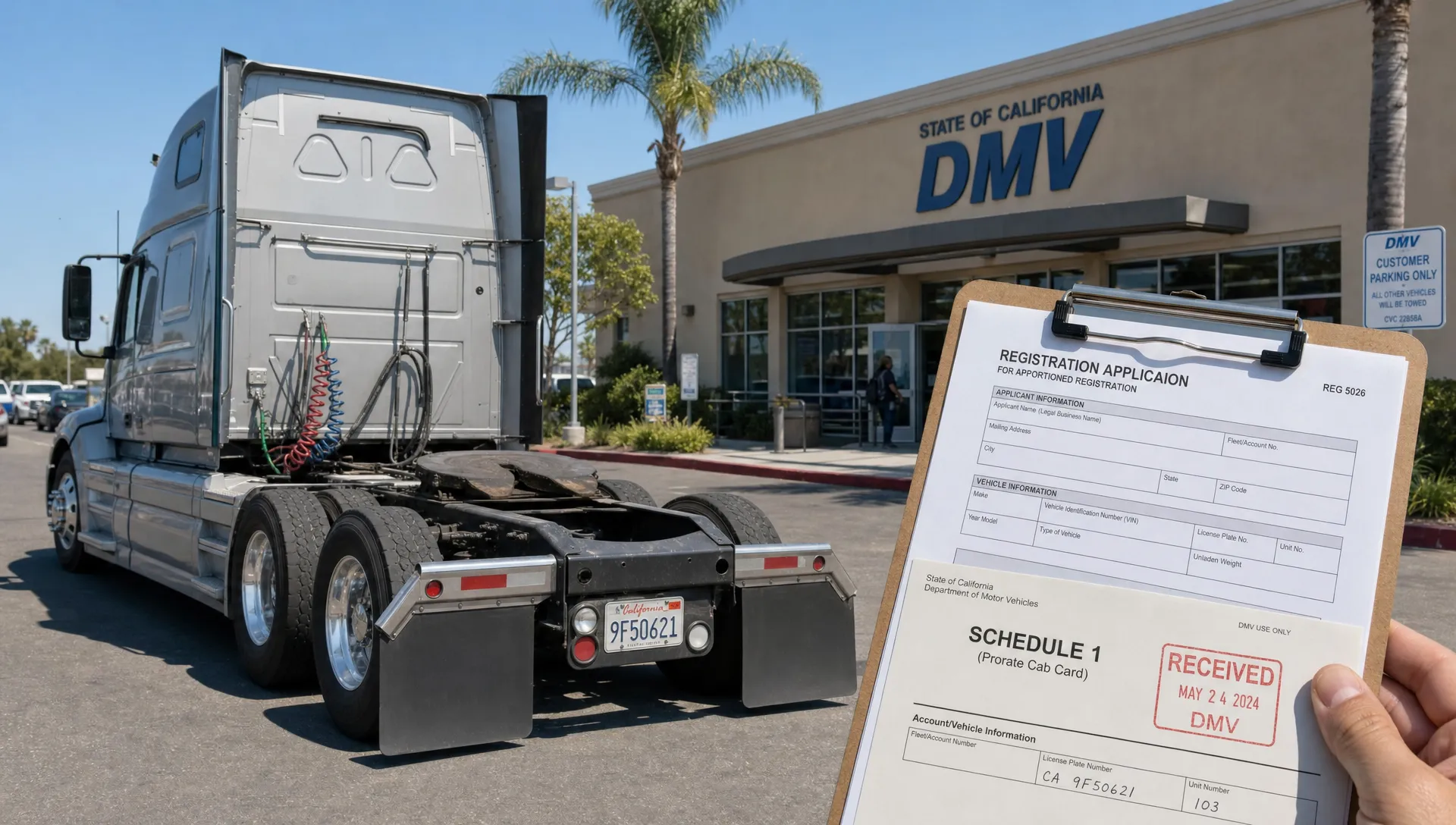
Many owners only discover the issue at the counter. They bring the title, proof of insurance and renewal notice, then learn that the DMV vehicle registration step cannot move forward because Schedule 1 is missing. That is why it is safer to file Form 2290 before you go to the DMV or before your IRP renewal appointment.
If you see “DMV California vehicle registration” in a search result, remember that the official agency is the California DMV. The key point is simple: the DMV registration file and the IRS Form 2290 filing need to show the same vehicle details, especially the VIN.
When Do California Truck Owners Need to File Form 2290?
You file Form 2290 by the last day of the month after the month the vehicle is first used on public highways during the tax period. This is the 2290 filing deadline rule that matters most for truck owners.
This is why California Vehicle Registration timing and the federal deadline need to be planned together. If your DMV renewal is due before you have an accepted Schedule 1, you may have to wait until the IRS accepts your filing.
| First use month on public highways | Form 2290 due date |
|---|---|
| July 2026 | August 31, 2026 |
| August 2026 | September 30, 2026 |
| September 2026 | October 31, 2026 |
| October 2026 | November 30, 2026 |
| November 2026 | December 31, 2026 |
| December 2026 | January 31, 2027 |
If a due date falls on a weekend or federal holiday, the IRS generally moves the due date to the next business day. For exact line by line filing rules, you can review the form 2290 irs instructions before submitting.
The filing is annual for taxable vehicles that remain in use. If you add another heavy vehicle during the year, you may need to file again for that vehicle based on its first use month.
What Happens If You Don't Have Schedule 1?
If your vehicle is subject to HVUT and you do not have a stamped Schedule 1, the California DMV registration renewal process can be held up. For a truck that needs to stay on the road, even a short delay can become expensive.
Possible problems include registration delays, IRP renewal delays, rejected paperwork and lost time at a DMV office. If the truck’s registration expires, you can also run into enforcement issues while operating or parking on public roads.
The IRS side has its own consequences. If you do not file Form 2290 on time or do not pay the HVUT tax, the IRS may assess penalties and interest. The DMV issue is often the first thing truck owners notice, but the tax issue remains federal.
VIN errors are another common headache. A single wrong character can make a valid Schedule 1 look unusable for DMV purposes. Before filing, compare the VIN against the title, prior registration and the physical VIN plate on the truck. Do not rely only on a handwritten note or old fleet spreadsheet.
Also keep state fees separate from federal HVUT. The California vehicle registration fee is a DMV charge and depends on vehicle type, location, value and other state or local items. Searches for vehicle registration fee California usually point to DMV fee calculators or renewal notices, not Form 2290. Paying one does not automatically satisfy the other.
How to E-File Form 2290 for a California Heavy Vehicle
E-filing is the fastest route for most truck owners because a stamped Schedule 1 can often be returned in minutes after IRS acceptance. E-file is also required if you report 25 or more taxable vehicles, but many single truck owners use it because paper filing can take much longer.
Here is the clean way to do it:
- Gather your EIN, business name, business address, VIN, taxable gross weight, first use month and payment method before you start.
- Make sure your EIN is active in IRS systems. A brand new EIN can take time to become available for electronic filing, so do not wait until the DMV deadline if you just formed a business.
- Enter the vehicle information exactly as it appears on your title or registration documents. Pay close attention to letters and numbers in the VIN.
- Choose the correct tax category based on taxable gross weight. Suspended vehicles are reported differently if they are expected to travel 5,000 miles or less during the tax period, or 7,500 miles or less for agricultural vehicles.
- Select an IRS payment option. Common options include electronic funds withdrawal, EFTPS, debit or credit card through an IRS approved payment processor, or check or money order.
- Submit through an IRS authorized 2290 e-file provider and wait for IRS acceptance.
- Download and save the stamped Schedule 1, then keep a copy for your records and provide it to the DMV or IRP office when requested.
A paper Form 2290 PDF still exists, but it is not ideal when you need a quick Schedule 1 for a California DMV visit. Paper filing can take weeks, and any mistake means more waiting.
Simple Form 2290 is built for truck tax filing and efile for truckers who want a guided process instead of wrestling with IRS forms. The platform supports single truck filings, bulk vehicle filings, Schedule 1 delivery, secure record retrieval and customer support, including English and Spanish help.
California Form 2290 FAQs
Does California Vehicle Registration require Form 2290?
Yes, if the vehicle is a qualifying heavy highway vehicle with a taxable gross weight of 55,000 lbs or more. The DMV may require an IRS stamped Schedule 1 before completing registration or renewal.
What is Form 2290 California used for?
It is a common way truck owners search for the federal HVUT filing needed when registering or renewing heavy vehicles in California. The form is filed with the IRS, and the stamped Schedule 1 is used as proof for the DMV.
What is vehicle registration?
Vehicle registration is the official DMV record that links a vehicle to its registered owner and gives that vehicle permission to operate or park on public roads when all requirements are met.
Can I fill out my own 2290 form?
Yes. You can prepare Form 2290 yourself, either on paper or through an online e-file system. For most truck owners, e-filing is easier because the system checks common errors and returns Schedule 1 much faster.
How much does Form 2290 cost?
The federal HVUT tax generally ranges from $100 to $550 per year for non logging taxable vehicles, depending on weight. Any e-file service fee and DMV fees are separate.
Does Form 2290 need to be filed every year?
Yes, in most cases. If your taxable heavy vehicle is used on public highways during the HVUT tax period, Form 2290 is generally filed annually. You may also need another filing if you add a vehicle during the year.
How do I fill out a 2290 form?
You need your EIN, legal business name, address, VIN, first use month, taxable gross weight and payment method. After the IRS accepts the filing, you receive Schedule 1 as proof.
What happens if you don't file 2290?
You may face IRS penalties and interest, and the California DMV may delay registration or renewal for a qualifying heavy vehicle until you provide accepted Schedule 1 proof.
How long does it take for the IRS to accept 2290?
E-filed returns are often accepted within minutes when the EIN, VIN and vehicle details are correct. Paper filing can take much longer. A new EIN or a VIN mistake can slow things down.
When is Form 2290 due for 2026?
For vehicles first used in July 2026, the due date is August 31, 2026. If first use is later in the tax year, the return is due by the last day of the month after the first use month.
Is California DMV registration renewal the same as paying HVUT?
No. California DMV registration renewal is the state process for renewing plates and registration. HVUT is the federal heavy vehicle use tax filed with the IRS on Form 2290.
Do I still need a DMV appointment if I e-file Form 2290?
E-filing gives you Schedule 1, but it does not automatically complete DMV registration. You still need to follow California DMV instructions for your specific registration, renewal or IRP transaction.
Need your stamped Schedule 1 before a DMV visit? File early, double check the VIN and keep both digital and printed copies with your registration records. A few minutes of review can save a wasted trip and keep your truck moving.
File Form 2290 Online Now