
09-02-2026
Form 2290 Fleet Compliance: A Guide for Trucking Companies


For a trucking company, Fleet Compliance is not just a safety file in the office. It includes drivers, vehicles, permits, taxes and the stamped Schedule 1 that proves your heavy vehicle use tax is current. If your trucks are 55,000 pounds or more, you can e-file Form 2290 online to keep HVUT records current without mailing paper forms or waiting weeks for proof.
Form 2290 is one of those jobs that feels small until it blocks a registration renewal, delays a truck from going on the road or creates a stack of IRS notices. For fleets, the real challenge is not knowing that Form 2290 exists. It is keeping every VIN, first use month, taxable gross weight category and Schedule 1 organized across multiple trucks.
What Is Fleet Compliance?
Fleet Compliance covers the rules a trucking company must follow to operate legally and safely. In daily operations, that usually includes driver qualification files, CDL and medical card tracking, hours of service records, ELD data, vehicle inspections, maintenance documentation, insurance, permits, registrations, IFTA, UCR and federal heavy vehicle use tax records.
If you have searched for “what is dot compliance,” the plain answer is this: DOT compliance is the set of safety and operating requirements that commercial carriers follow under the U.S. Department of Transportation and the Federal Motor Carrier Safety Administration. The related search “what is dot” usually points to the Department of Transportation, the federal agency tied to many trucking safety and operating rules.
A practical dot fleet compliance process connects safety records with tax and registration documents so an expired medical card, missed inspection or missing Schedule 1 does not surprise your team at renewal time. You may also see fmcsa compliance used online for the FMCSA side of the same safety recordkeeping conversation, especially around driver files, vehicle inspections and hours of service.
Some carriers use dot compliance services for driver qualification files, safety audits and permit tracking. Others hire trucking compliance services when their fleet grows beyond what one dispatcher or office manager can reasonably handle. Those services can help, but the carrier still needs clean internal records for every truck and driver.
What Is Form 2290 and Why Does It Matter for Fleets?
IRS Form 2290 is the annual federal tax return used to report and pay Heavy Vehicle Use Tax, often called HVUT, for heavy highway motor vehicles. In general, it applies to vehicles with a taxable gross weight of 55,000 pounds or more that are used on public highways.
The IRS explains Form 2290 requirements in its official Instructions for Form 2290. For fleets, the key point is simple: if a taxable truck is on the road, the company needs to know whether Form 2290 has been filed, whether tax has been paid or suspended and whether the stamped Schedule 1 is stored where the registration team can find it.
Fleet operators reporting 25 or more taxable vehicles on a return must file electronically. Smaller fleets can often choose paper filing, but e-filing is usually faster because the accepted Schedule 1 can be returned much sooner than a mailed return.
Form 2290 matters because it ties tax compliance directly to vehicle registration. A truck may be insured, inspected and ready to haul, but if the required HVUT record is missing, DMV registration or renewal can become a problem.
How Form 2290 Supports Fleet Tax Compliance
Form 2290 supports fleet tax compliance by creating a clear tax record for each heavy vehicle. It helps your office answer basic questions quickly: Which trucks are taxable? Which trucks are suspended because they stay under the mileage limit? Which new units need a separate filing because they were first used after July?
Treat Form 2290 as part of dot fleet compliance, not as a once a year tax errand. When HVUT records sit in a separate folder with no connection to registrations, permits and VIN lists, mistakes are more likely. A better process keeps Form 2290 data connected to the same master vehicle records your team already uses.
Good dot compliance services can remind a fleet when safety credentials are expiring, but HVUT filing still needs accurate tax data from your operation. Form 2290 supports that recordkeeping in several practical ways:
- It links each taxable VIN to a filed return.
- It documents the taxable gross weight category used for HVUT.
- It gives your registration team proof through Schedule 1.
- It helps identify vehicles that need amended filing, VIN correction or mileage status review.
For a growing fleet, this is less about tax paperwork and more about keeping trucks available for work.
Which Fleet Vehicles Are Subject to Form 2290?
Form 2290 generally applies when a highway motor vehicle has a taxable gross weight of 55,000 pounds or more and is used on public highways. Taxable gross weight is not just the empty weight of the truck. It generally includes the unloaded weight of the vehicle, the unloaded weight of trailers customarily used with it and the maximum load customarily carried.
Here is a quick way to sort common fleet vehicle situations:
| Vehicle situation | Form 2290 treatment | What fleet managers should check |
|---|---|---|
| Vehicle under 55,000 pounds | Usually not subject to HVUT | Keep weight records in case registration or audit questions come up |
| Vehicle 55,000 pounds or more used on public highways | Usually taxable | File Form 2290 using the correct first use month and weight category |
| Vehicle expected to travel 5,000 miles or less | Usually reported as suspended | Agricultural vehicles generally use a 7,500 mile limit |
| Logging vehicle 55,000 pounds or more | Usually reported on Form 2290 | Logging vehicles may fall under different tax categories |
| Vehicle first used after July | File after the first use month | Do not wait for the next annual cycle if the truck is already on the road |
Suspended does not always mean ignored. In many cases, a suspended vehicle still needs to be reported on Form 2290, but no tax is due unless it exceeds the mileage limit.
When Should Fleets File Form 2290?
The standard Form 2290 rule is based on the month a vehicle is first used on public highways during the tax period. The return is generally due by the last day of the month following the month of first use.
For vehicles first used in July 2026, the regular 2290 filing deadline is August 31, 2026. This is the date many fleets think of as the annual HVUT deadline. If a truck is first used later in the year, the deadline moves based on that later first use month.
| First use month | General filing deadline |
|---|---|
| July 2026 | August 31, 2026 |
| August 2026 | September 30, 2026 |
| September 2026 | October 31, 2026, adjusted if the due date falls on a weekend or federal holiday |
| January 2027 | Last day of February 2027, adjusted if applicable |
A common fleet mistake is filing for the trucks active in July, then forgetting about trucks added in October, December or March. Every newly placed taxable vehicle needs its own deadline review.
Why Is Schedule 1 Important for Fleet Compliance?
Schedule 1 is the IRS stamped proof that your Form 2290 was accepted. For trucking companies, it is one of the most important HVUT documents because state registration offices commonly require it before issuing or renewing registration for heavy vehicles.
A stamped Form 2290 Schedule 1 can show the VINs reported on the return and confirm that the IRS accepted the filing. For a fleet office, that proof should be stored by tax year, unit number and VIN so the right document can be pulled within minutes.
When a truck is sitting at renewal time and the Schedule 1 is missing, the issue becomes operational. The tax may have been paid, but if nobody can locate the accepted proof, the truck can still be delayed. That is why Schedule 1 retrieval and storage should be part of your regular vehicle documentation routine.

What Happens If a Fleet Misses the Form 2290 Deadline?
If a fleet misses the Form 2290 deadline, the IRS may assess penalties and interest. The exact amount depends on the situation, how late the return is and whether the tax was paid late. More importantly for day to day operations, a missing Schedule 1 can create registration problems.
Late filing can also make internal records messy. One missed truck often leads to more questions: Was the VIN entered correctly? Was the unit first used in the month shown on the return? Was it taxable or suspended? Did the tax department know the truck had been placed in service?
Even if you use trucking compliance services, keep a copy of every accepted Schedule 1 in your own files. Outside help is useful, but your team should still be able to prove filing status during a registration renewal, internal audit or sale of equipment.
If you missed a deadline, do not wait for the problem to grow. File as soon as possible, pay any tax due, keep proof of submission and store the accepted Schedule 1 once it is returned.
How to Simplify Form 2290 Filing for Multiple Vehicles
Managing one truck is one record. Managing 20, 50 or 200 trucks is a data quality problem. The easiest way to simplify Form 2290 filing is to build a repeatable process before the annual deadline rush.
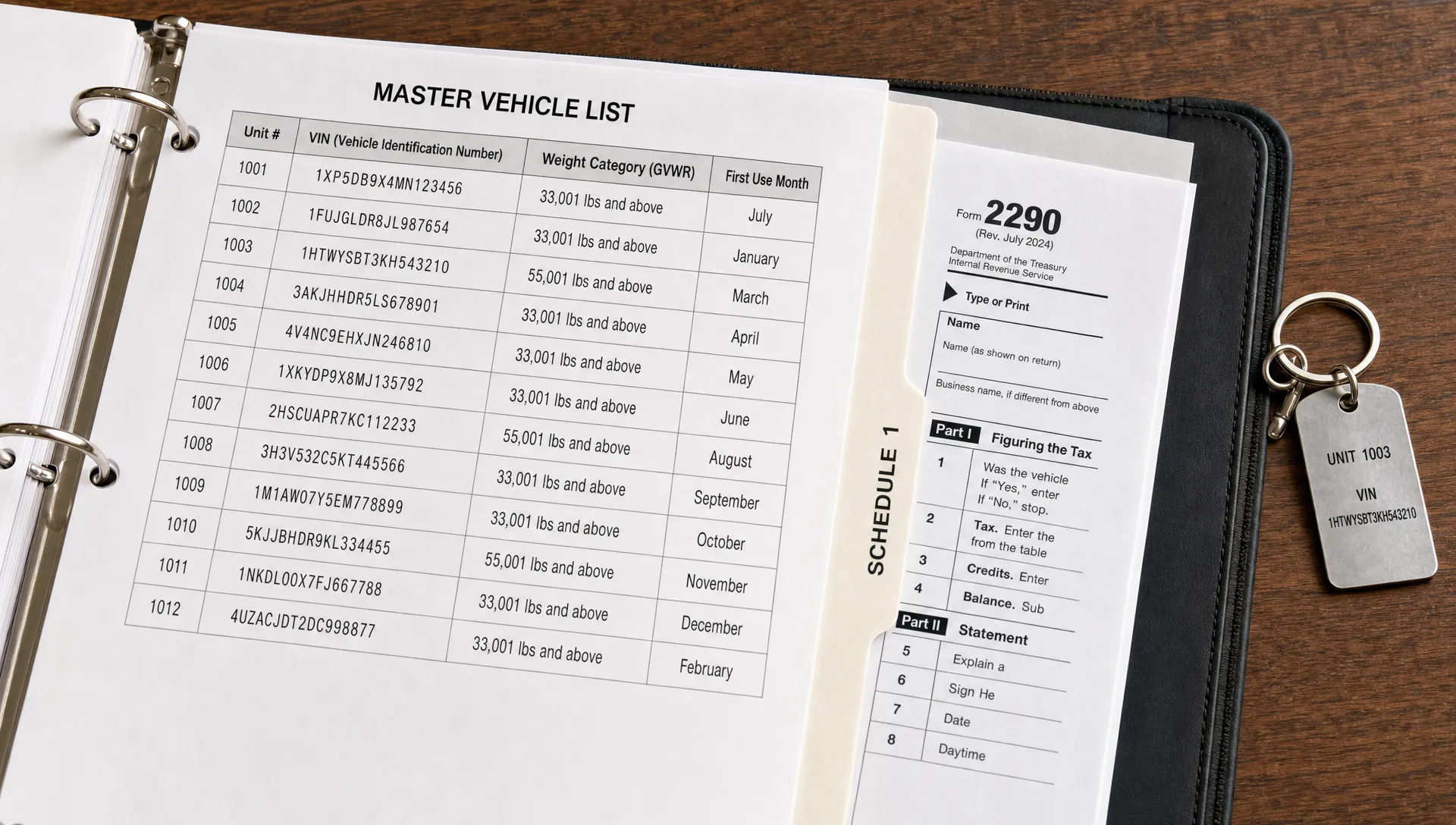
Start with a master vehicle list that includes unit number, VIN, taxable gross weight category, logging status, suspended status, first use month and current registration status. Then review that list against the trucks that were actually used on public highways during the tax period.
For fleets, an IRS authorized online filing portal can reduce manual work. Simple Form 2290 supports online filing, bulk vehicle filings, a guided process, data retrieval, secure filing, customer support and English or Spanish assistance. That matters when your office is handling many VINs and cannot afford avoidable mistakes.
A clean process usually looks like this:
- Confirm the EIN and legal business name before filing.
- Check each VIN against the registration document.
- Assign the correct taxable gross weight category.
- Separate taxable, suspended and logging vehicles.
- File electronically if reporting 25 or more taxable vehicles.
- Save the accepted Schedule 1 in a shared compliance folder.
- Add the next HVUT deadline to your fleet calendar.
If your office is also tightening driver time records, the guide What Is ELD Compliance explains the ELD side of compliance so HVUT, HOS and safety documents stay aligned.
Form 2290 Fleet Compliance Checklist
Use this Fleet Compliance checklist before you submit your next Form 2290 return or renew heavy vehicle registrations:
- EIN is active and matches the business name on IRS records.
- Every taxable VIN has been checked for accuracy.
- Vehicle unit numbers match your internal fleet list.
- Taxable gross weight category is confirmed for each truck.
- First use month is correct for every vehicle added during the year.
- Suspended vehicles are marked and mileage limits are monitored.
- Logging vehicle status is reviewed where applicable.
- E-file requirement is checked if 25 or more taxable vehicles are reported.
- IRS payment method is selected and confirmed.
- Stamped Schedule 1 is saved by tax year, VIN and unit number.
- Registration team knows where to find accepted Schedule 1 copies.
- A reminder is set before the next annual August deadline.
The best checklist is the one your office can follow under pressure. If it is too complicated, it will not survive deadline week.
FAQs About Fleet Compliance and Form 2290
Who is required to file a Form 2290?
Owners of heavy highway motor vehicles with a taxable gross weight of 55,000 pounds or more generally must file Form 2290 if the vehicle is used on public highways. This includes trucking companies, owner operators and fleet owners.
Are IFTA and Form 2290 the same?
No. IFTA is used for reporting and paying fuel taxes for interstate motor carriers. Form 2290 is for federal heavy vehicle use tax. Many fleets deal with both, but they are separate requirements.
How much does a 2290 cost per year?
The HVUT amount depends on taxable gross weight, vehicle type and first use month. For a non-logging vehicle at 75,000 pounds or more used for a full tax year, the federal HVUT can be $550. E-file provider fees are separate from the IRS tax amount.
Can I fill out my own 2290 form?
Yes. You can prepare Form 2290 yourself, but fleets reporting 25 or more taxable vehicles on a return must file electronically. Many companies still choose e-file because it is faster and reduces mailing delays.
Who is exempt from filing Form 2290?
Vehicles under 55,000 pounds are generally not subject to HVUT. Certain government, nonprofit emergency and qualified exempt vehicles may also be exempt under IRS rules. Suspended vehicles are different because they may still need to be reported even when no tax is due.
What happens if you do not file 2290?
The IRS may charge penalties and interest, and you may have trouble renewing vehicle registration without a stamped Schedule 1. Late filing should be handled as soon as possible.
When is Form 2290 due for 2026?
For vehicles first used in July 2026, Form 2290 is generally due August 31, 2026. For vehicles first used in later months, the return is generally due by the last day of the following month.
Do fleets with 25 or more trucks have to e-file?
If a return reports 25 or more taxable vehicles, IRS rules require electronic filing. Fleets with fewer vehicles can often e-file too, and many do because Schedule 1 delivery is faster than paper filing.
Form 2290 filing is easier when it is treated as part of your regular truck recordkeeping, not as a last minute tax task. Gather your EIN, VINs, weight categories and first use months early, then file before the deadline so your trucks stay ready for the road.
File Form 2290 Online Now