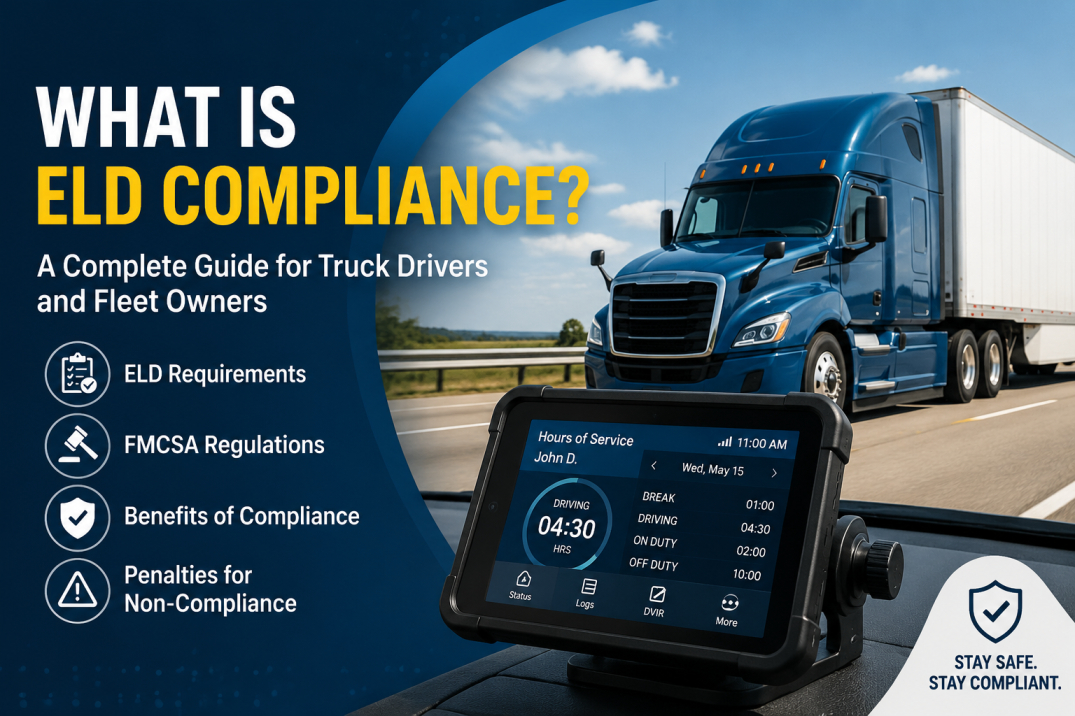
 regulations that require commercial drivers to use Electronic Logging Devices (ELDs) to record Hours of Service (HOS). Understanding ELD requirements helps trucking companies improve safety, avoid violations, reduce paperwork, and maintain compliance with federal regulations. This guide explains how ELD compliance works, who must comply, exemptions, benefits, common challenges, and best practices for truck drivers and fleet owners.&p[url]=https://www.simpleform2290.com/blog/what-is-eld-compliance-guide-for-truck-drivers-and-fleet-owners&p[images][0]=https://www.simpleform2290.comhttps://simpleform2290.com/blog_image/What Is ELD Compliance.jpg)

ELD compliance is the federal mandate that requires most commercial truck drivers to use an electronic logging device to record their hours of service automatically. If you operate a heavy vehicle, understanding ELD compliance rules is not optional. It directly affects your roadside inspection results, your CSA score, and your ability to stay on the road.
What Is ELD Compliance?
ELD compliance meaning, in plain terms: your commercial motor vehicle must be equipped with a registered electronic logging device that automatically records driving time, engine hours, vehicle movement, and location data. These records replace the paper logbooks drivers once filled out by hand.
The Federal Motor Carrier Safety Administration (FMCSA) introduced the ELD mandate to reduce hours-of-service (HOS) violations, driver fatigue, and falsified logbooks. The ELD compliance rules have been in full effect since 2019, and roadside inspectors now verify electronic logs during every DOT inspection.
What does the ELD stand for? ELD stands for Electronic Logging Device. The full regulatory framework is set out under 49 CFR Part 395, specifically Section 395.15 for ELD use and Section 395.24 for unidentified driving.
Who Needs an ELD?
DOT ELD compliance applies to most commercial motor vehicle (CMV) operators. You are required to use an ELD if you:
Records of Duty Status (RODS)
You must keep RODS for more than 8 days out of any 30-day period. Occasional or part-time drivers who log 8 days or fewer in 30 days may qualify for an exemption.
Vehicle Weight and Cargo
You operate a CMV with a gross vehicle weight rating (GVWR) over 10,000 lbs, or you transport placardable hazardous materials requiring a CDL.
ELD fleet compliance also covers any motor carrier whose drivers operate vehicles in interstate commerce under those same thresholds. If you manage a fleet, every driver subject to HOS rules must be covered by your ELD program.
ELD Exemptions
Not every truck driver must use an ELD. The FMCSA recognizes four categories of drivers who may operate without one:
| Exemption Category | Who Qualifies |
|---|---|
| Pre-2000 Engine Vehicles | CMVs with engine model years older than 2000, where the engine cannot interface with an ELD. |
| Short-Haul Drivers | Drivers who operate within a 150 air-mile radius and return to their home terminal within 14 consecutive hours each day. |
| Driveaway-Towaway Operations | Drivers transporting a vehicle that is itself the commodity being delivered (e.g., new vehicle delivery). |
| Occasional Loggers | Drivers who are required to keep RODS for 8 days or fewer within any 30-day rolling period. |
Can you run a truck without an ELD? Only if you fall into one of the categories above. Any driver outside these exemptions who operates without a compliant device is subject to immediate out-of-service orders and civil penalties. Always verify your eligibility against the current FMCSA regulations before relying on an exemption.
Core ELD Compliance Rules
The three technical pillars of ELD mandate compliance cover what the device must record, how it transfers data, and which devices are legally acceptable.
1. Automatic Recording
The device must connect directly to the vehicle's engine control module and record driving time, engine-on/off status, miles driven, and GPS-based location without driver input. Manual entry of driving time is a form-and-manner violation under 49 CFR 395.24.
2. Data Transfer to Safety Officials
During a roadside inspection, drivers must be able to transfer current and previous 7-day logs to law enforcement via one of four approved methods: wireless web services, USB 2.0, Bluetooth, or email (where allowed). California new laws on ELD compliance and several other state-level enforcement programs have expanded the scope of inspections where this transfer is tested.
3. FMCSA-Registered Devices Only
ELD fleet compliance requires that every device in use be self-certified by its manufacturer and listed on the FMCSA ELD registry at eld.fmcsa.dot.gov. Devices not on that list do not satisfy DOT ELD compliance requirements, regardless of how they function.
What are three types of ELDs? The FMCSA does not formally categorize ELDs by "type," but the industry generally groups them as: (1) integrated cab-mounted units hard-wired to the ECM, (2) portable tablet or smartphone-based systems using a certified ECM adapter, and (3) telematics-integrated fleet management systems that combine ELD functions with GPS and asset tracking.
Can I use my phone as an ELD device? A smartphone can serve as the display for a compliant ELD system only if the phone app is paired with a certified FMCSA-registered ECM hardware adapter. The phone app alone, without certified hardware, does not satisfy ELD compliance.
Common ELD Violations and Penalties
ELD violations fall into two main categories under FMCSA rules: form and manner violations and hours-of-service violations. Both types affect your CSA score and can result in out-of-service orders.
ELD Violation Points and CSA Impact
Each violation carries a severity weight in the FMCSA's Safety Measurement System (SMS). A 395.8 log-not-current violation carries a severity weight of 5. A 395.24(d) violation for failing to transfer ELD data during an inspection carries a severity weight of 5 as well. These points accumulate against your carrier's BASIC scores and remain visible for 24 months.
Penalties for Non-Compliance
Failing to maintain or produce compliant ELD records can result in civil penalties exceeding $13,000 per violation for carriers and up to $16,000 per violation for egregious or willful cases. In addition:
Out-of-Service Orders
A driver without a compliant ELD or without proper logs can be placed out of service immediately at the inspection point until the situation is corrected.
FMCSA Form and Manner Regulations
FMCSA form and manner regulations (49 CFR 395.8) require that logs be accurate, current to within the last hour, and signed. Missing annotations, unsigned records, and incorrect duty status entries all constitute form and manner violations under these rules.
Common moving violations that coincide with ELD issues include speeding, following distance infractions, and lane-change violations, all of which compound CSA scores when a driver is also found with HOS or ELD deficiencies at the same inspection.
Common ELD Compliance Challenges and How to Fix Them
These are the five most frequent common challenges ELD compliance USA fleets encounter, along with actionable fixes for each.
The Challenge
Drivers frequently cannot complete the electronic log transfer to inspectors during a roadside stop. This is one of the top triggers for 395.24(d) violation points.
The Fix
Train every driver on all four approved transfer methods (wireless, USB, Bluetooth, email). The cab must also carry an ELD instruction sheet and eight days of blank paper logs as a backup in case of a device malfunction.
The Challenge
When a truck moves without an authenticated driver logged in (during a yard move, fueling, or a pre-trip by a different person) the ELD creates "unassigned" driving records. Leaving these unresolved is a direct violation.
The Fix
Fleets must run daily unassigned-driving reports. At each login, drivers must actively accept or reject any unassigned segments. Carriers are responsible for resolving all unidentified driving within the current day plus the 8-day look-back period.
The Challenge
Hardware connectivity failures, ECM sync errors, and portable device mounting problems can trigger diagnostic events that flag the record as non-compliant during an inspection.
The Fix
Drivers must report any ELD malfunction to the carrier within 24 hours. The carrier then has 8 days to repair or replace the device. During that window, the driver reverts to paper logs and must annotate them with a note explaining the malfunction.
The Challenge
Drivers who incorrectly use Personal Conveyance (PC) status or fail to annotate Yard Move events create records that appear falsified during an audit, even when the actual driving was legal.
The Fix
Ongoing training is required, not just at onboarding. Drivers must annotate every duty status change in real time, and fleet managers should audit PC usage monthly to catch misuse patterns before an inspector does.
The Challenge
ELD compliance impact on fleet operations USA goes beyond the device itself. Inspectors check for three physical documents in the cab: the ELD user manual, a data transfer instruction sheet, and a malfunction reporting instruction sheet. Missing any one of them is a citable violation.
The Fix
Create a laminated cab document packet for every truck. Verify the packet is in place during every pre-trip inspection as part of the standard checklist.
Best ELD Solutions for FMCSA Compliance 2026
Choosing the best ELD solutions FMCSA compliance 2026 comes down to three factors: the device must be on the FMCSA registry, it must support all four data transfer methods, and it must integrate with your dispatch or fleet management system without creating administrative gaps.
For owner-operators, ELD devices for owner operators that combine compliance with IFTA mileage tracking reduce duplicate data entry across filings. The best compliance software for ELD and IFTA filing automates fuel tax calculations at the state level while maintaining the same HOS records your ELD already captures, removing one of the most common administrative pain points for independent drivers.
When evaluating platforms, confirm that the software vendor updates device firmware in response to FMCSA regulatory changes, and check whether the system flags unassigned driving and data diagnostic events automatically so your compliance team does not have to monitor logs manually.
What are the 4 domains of ELD? The FMCSA's ELD technical standard organizes requirements into four functional domains: (1) Engine Synchronization, where the device reads RPM, speed, and odometer directly from the ECM; (2) Driver Authentication, drivers log in by entering their CMV credentials before any movement begins; (3) Record Keeping, where the device automatically records duty status, location, distance, and engine data; and (4) Data Transfer, the system supports all approved transfer modes for inspector access.
How much does ELD cost per month? Subscription costs for FMCSA-registered ELD systems typically range from about $20 to $45 per vehicle per month for standard HOS-only devices. Full fleet telematics platforms that add GPS tracking, IFTA reporting, and driver scoring run higher, from $35 to $80 per vehicle per month depending on the provider and contract length.
Form 2290, HVUT, and Fleet Compliance
ELD compliance and HVUT filing are two separate federal obligations that apply to the same vehicles. If you operate a heavy vehicle subject to ELD mandate compliance, you almost certainly also need to file IRS Form 2290 and pay the Heavy Vehicle Use Tax (HVUT).
The IRS 2290 form applies to any vehicle with a gross weight of 55,000 lbs or more that is used on public highways. The HVUT tax year runs from July 1 to June 30, and the Form 2290 filing deadline for vehicles first used in July is August 31. HVUT form 2290 filings must be accompanied by a valid EIN, the IRS will not process the 2290 tax form without one.
The IRS Form 2290 must be filed electronically through an IRS-authorized e-file provider when a fleet has 25 or more vehicles. Once the IRS processes your HVUT 2290 form, you receive a stamped Schedule 1 Form 2290 as proof of payment. That Schedule 1 Form 2290 is required by state DMVs to renew registration for any vehicle over 55,000 lbs.
The 2290 form IRS threshold is 55,000 lbs gross vehicle weight. Vehicles weighing less than 55,000 lbs are considered suspended vehicles and still require a 2290 form filing but owe no tax. The form 2290 filing covers a single tax year and must be renewed annually. If you add a new vehicle mid-year, the first use month determines your 2290 form 2026 or 2027 tax period and prorated tax amount. File form 2290 online through an IRS-authorized provider to receive your stamped Schedule 1 in minutes rather than weeks. Simpleform2290.com is an IRS-authorized e-file provider that makes it straightforward to file 2290 online, receive your HVUT Schedule 1, and stay current with IRS 2290 requirements, all in one place.
For a deeper look at the tax itself, see our guide to what is Form 2290 and the Form 2290 instructions page. If you operate agricultural vehicles, check whether the farmers and agricultural exemption reduces or eliminates your HVUT liability.
Frequently Asked Questions
What does ELD stand for?
ELD stands for Electronic Logging Device. It is the hardware mandated by the FMCSA under 49 CFR Part 395 that connects to a commercial motor vehicle's engine to automatically record hours of service and records of duty status, replacing manual paper logbooks.
Can you run a truck without an ELD?
Most commercial truck drivers cannot legally operate without a compliant ELD. Exemptions exist for drivers with pre-2000 engine vehicles, short-haul operators within a 150 air-mile radius, driveaway-towaway drivers, and occasional loggers who maintain RODS for 8 days or fewer per 30-day period. All other drivers subject to HOS rules must use an FMCSA-registered ELD.
How much does ELD cost per month?
Standard FMCSA-registered ELD subscriptions typically cost between $20 and $45 per truck per month for basic HOS logging. Full-featured fleet telematics platforms with GPS, IFTA mileage reporting, and driver scoring can run from $35 to $80 per vehicle per month. Hardware costs vary by provider and are sometimes bundled into the subscription.
What are common ELD violations?
The most common ELD violations include: failing to transfer log data during a roadside inspection (395.24(d)); unresolved unassigned driving time; operating with an ELD malfunction without reverting to paper logs; missing required cab documentation; and form and manner violations such as unsigned or unannotated records. ELD violation points from these infractions remain on your FMCSA safety record for 24 months.
What are three types of ELDs?
The industry groups compliant devices into three categories: permanently mounted cab units hard-wired to the ECM, portable tablet or smartphone-based displays paired with a certified ECM adapter, and full telematics platforms that integrate HOS logging with GPS tracking and fleet management. All three must be self-certified and listed on the FMCSA ELD registry to satisfy DOT ELD compliance.
What are the 4 domains of ELD?
The four functional domains in the FMCSA ELD technical standard are: Engine Synchronization (reading engine data directly from the ECM), Driver Authentication (CMV login before movement), Record Keeping (automatic duty status and location capture), and Data Transfer (support for all approved transfer methods during inspections).
Can I use my phone as an ELD device?
A smartphone can function as the display and interface for a compliant ELD system only when paired with a certified FMCSA-registered ECM hardware adapter. The phone app alone does not satisfy ELD compliance. The physical adapter, which connects to the vehicle's diagnostic port and reads engine data, is what must appear on the FMCSA ELD registry.
How long does a log book violation stay on your record?
ELD and logbook violations stay on your FMCSA safety record for 24 months from the inspection date. If you believe a violation was recorded in error, you can file a DataQ challenge with the FMCSA to request a correction.
What is a 2290 form and how does it relate to trucking compliance?
The IRS Form 2290 is the Heavy Vehicle Use Tax (HVUT) return that most commercial truck operators must file annually for vehicles over 55,000 lbs. It is separate from ELD compliance but applies to the same class of vehicles. After filing, you receive a stamped Form 2290 Schedule 1 as proof of HVUT payment, which is required for vehicle registration renewal. You can file 2290 online through SimpleForm2290, an IRS-authorized e-file provider, and receive your Schedule 1 almost immediately upon IRS acceptance.