
08-27-2026
Highway-Use Tax Exemption Certificate: A Complete Guide for Truck Owners
 truck owners actually need for registration.&p[url]=https://www.simpleform2290.com/blog/highway-use-tax-exemption-certificate&p[images][0]=https://www.simpleform2290.comhttps://simpleform2290.com/blog_image/Highway-Use Tax Exemption Certificate.png)

If you own or operate a heavy truck, a highway-use tax exemption certificate can feel like one more DMV phrase standing between you and your next load. The key is knowing whether you are dealing with federal HVUT, state HUT rules or a vehicle transfer tax. If your truck is 55,000 pounds or more and you need to file Form 2290 online, the federal filing is usually handled through IRS Form 2290 and your accepted Schedule 1, not a separate federal certificate.
Quick answer for truck owners
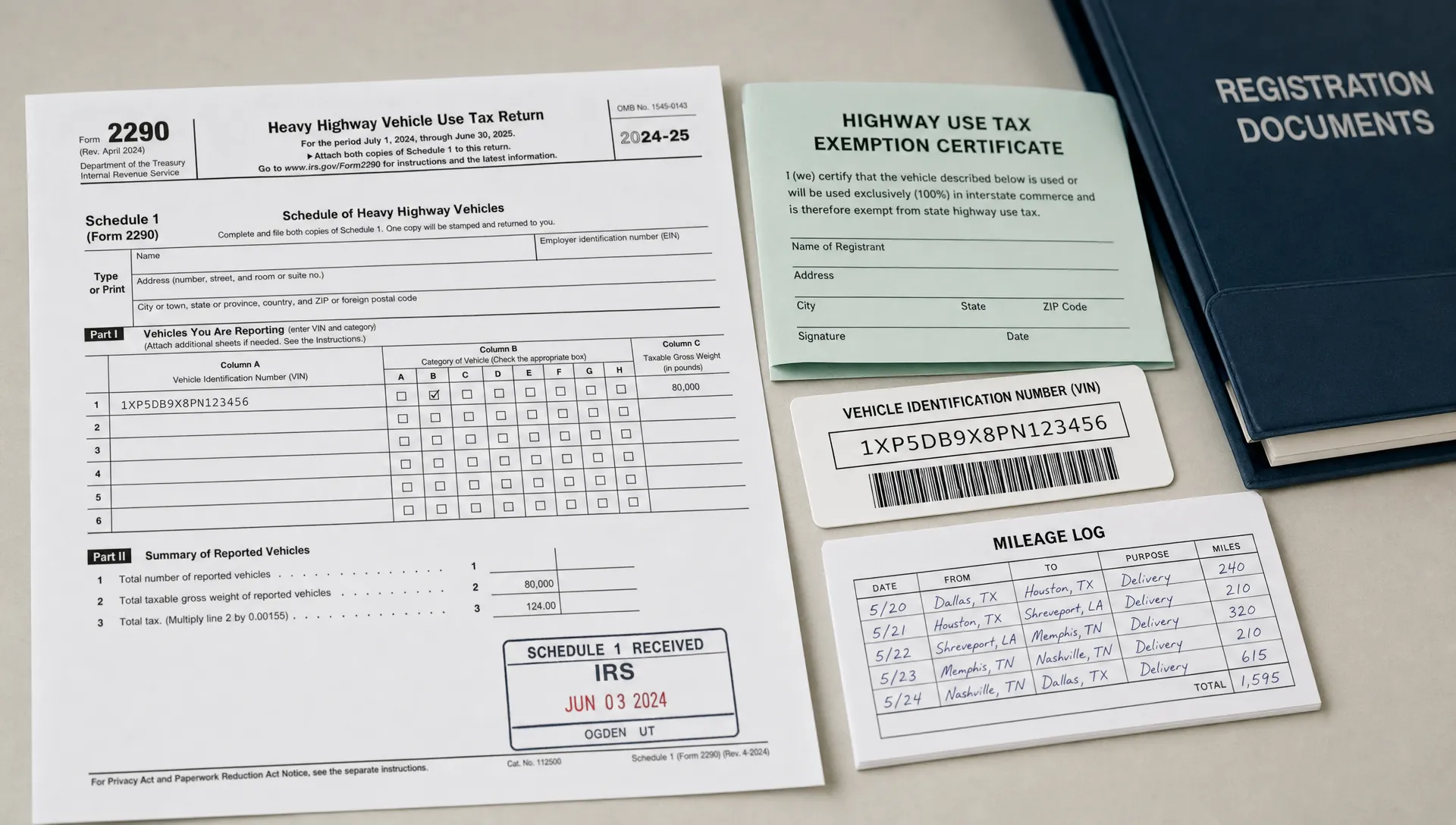
For federal Heavy Vehicle Use Tax, there is no standalone IRS exemption certificate that replaces Form 2290. If your vehicle qualifies as tax-exempt or suspended from tax because of low mileage, you still report that status on Form 2290 and receive a stamped or watermarked Schedule 1 as proof for registration.
State rules are different. Some states use highway use tax certificates, permits or exemption forms for registration, title transfers or state road-use taxes. New York HUT, for example, is not the same thing as federal HVUT. North Carolina has a highway-use tax exemption certification for certain vehicle title transfers. The name sounds similar, but the filing purpose is different.
In plain terms:
- Federal HVUT for trucks at 55,000 pounds or more is handled on IRS Form 2290.
- Low-mileage vehicles are usually suspended, not automatically ignored.
- State exemption certificates depend on the state, the vehicle type and the transaction.
- Your 2290 Schedule 1 is often the document the DMV wants before it renews plates or registration.
What is a 2290 and how does it connect to exemptions?
Form 2290 is the IRS return used to report and pay the Heavy Highway Vehicle Use Tax on taxable highway motor vehicles. Truckers also call it the heavy highway use tax form 2290, hvut form 2290, hvut 2290 form or form 2290 heavy highway vehicle use tax return. They all point to the same federal filing.
According to the IRS Form 2290 page, the form applies to highway motor vehicles with a taxable gross weight of 55,000 pounds or more that are registered, or required to be registered, in your name under state, District of Columbia, Canadian or Mexican law.
The 2290 instructions matter because the IRS does not treat every heavy vehicle the same way. Some vehicles owe the full HVUT tax. Some are suspended because they stay under mileage limits. Some are exempt because of the owner or the vehicle's specific use. For line-by-line help, compare your return with the updated form 2290 instructions 2026 before submitting.
For the 2026 tax period, the regular filing season covers vehicles first used in July 2026 for the period July 1, 2026 to June 30, 2027. The usual 2290 filing deadline for those July first-use vehicles is August 31, 2026. If the first use month is later than July, the return is due by the last day of the month after the first use month.
What truck owners usually mean by an exemption certificate
In federal HVUT terms, a highway-use tax exemption certificate is not a standalone IRS certificate. The IRS wants the vehicle reported correctly on Form 2290, then it issues an accepted Schedule 1 after processing.
That Schedule 1 is the proof most truck owners need for DMV, IRP or registration work. It may show a taxable vehicle, a suspended vehicle or certain exempt vehicles depending on how the return is filed. If you walk into the DMV asking for a certificate, they may actually be looking for your stamped 2290 Schedule 1.
This is where many owner-operators lose time. A truck can qualify for no tax due, but the filing may still be required. No tax due does not always mean no paperwork due.
Federal Form 2290 exemptions and suspended vehicles
Federal HVUT has a few common situations where tax is not paid or is reduced. The most common for small fleets is the suspended vehicle rule. A suspended vehicle is expected to travel 5,000 miles or less on public highways during the tax period. Agricultural vehicles get a higher limit of 7,500 miles.
For federal trucks, the practical equivalent of a highway-use tax exemption certificate is an accepted Form 2290 with a stamped or watermarked 2290 Schedule 1. It proves you filed and reported the vehicle correctly.
| Vehicle or owner status | What it means | Form 2290 action | Proof you keep |
|---|---|---|---|
| Taxable heavy vehicle | 55,000 pounds or more and above the mileage suspension limit | File and pay HVUT | Stamped Schedule 1 |
| Suspended commercial vehicle | Expected to travel 5,000 miles or less | File as suspended, usually no HVUT payment | Stamped Schedule 1 |
| Suspended agricultural vehicle | Expected to travel 7,500 miles or less | File as suspended agricultural vehicle | Stamped Schedule 1 |
| Government or qualifying exempt owner | Certain federal, state, local, tribal and other qualifying entities | Report exemption as required | Accepted filing records |
| Vehicle exceeds suspended mileage | Vehicle later goes over the mileage limit | File an amendment and pay tax | Updated records and payment proof |
Some vehicles are not treated as highway motor vehicles for HVUT purposes. Examples can include certain mobile machinery, non-transportation equipment or vehicles specially designed for off-highway work. Do not assume based on looks alone. The IRS focuses on design, registration, highway use and weight.
When a highway-use tax exemption certificate applies at the state level
State highway use tax rules are where the word certificate shows up more often. A highway-use tax exemption certificate may be requested during a title transfer, registration transaction or state tax process. The form, eligibility and deadline depend on the state.
New York is a good example of why truck owners need to separate federal and state taxes. New York's Highway Use Tax applies to certain motor carriers operating on New York public highways and is administered by the New York State Tax Department. It has its own registration and certificate rules. If you operate in New York, review the difference between New York HUT vs Federal HVUT before assuming your federal Form 2290 covers everything.
State exemption categories often include government vehicles, tribal vehicles, qualifying nonprofit or emergency vehicles, family transfers, inheritances, certain farm uses or special registration situations. The supporting documents may include a VIN, vehicle weight, owner information, proof of nonprofit status, government ownership documents or a transfer affidavit.
If the filing is state-related, start with your state DMV, department of revenue or tax department. If the filing is federal HVUT-related, start with Form 2290.
Who is required to file Form 2290?
You generally file Form 2290 if a highway motor vehicle has a taxable gross weight of 55,000 pounds or more and is used on public highways. The vehicle must also be registered, or required to be registered, in your name.
Taxable gross weight usually includes the unloaded weight of the truck, the unloaded weight of trailers or semi-trailers customarily used with it and the maximum load customarily carried. This is why two trucks that look similar can fall into different tax categories.
At what weight is a 2290 required? The key federal threshold is 55,000 pounds. Below that, federal HVUT normally does not apply. At 55,000 pounds or more, you need to check whether the vehicle is taxable, suspended or exempt.
Food trucks, dump trucks, semi-trucks, logging trucks, buses and heavy service vehicles can all raise Form 2290 questions if they meet the weight and highway-use tests. The purpose of Form 2290 is to collect federal road-use tax from heavy vehicles that place more wear on public highways.
2290 cost per truck: tax, filing fee and zero-tax returns
Your form 2290 cost has two parts: the IRS tax itself and any service fee charged by the e-file provider. The federal HVUT amount depends mainly on taxable gross weight, first-use month and whether the vehicle qualifies for a special status such as logging or suspension.
For a standard taxable vehicle, HVUT starts at 55,000 pounds and increases by weight category. The top standard annual federal tax is commonly $550 for vehicles at 75,000 pounds or more when taxable for the full period. Suspended vehicles may have no federal tax due, but they still may need to be filed so you can get Schedule 1 proof.
| Cost item | What truck owners should know |
|---|---|
| IRS HVUT tax | Based on weight, first-use month and vehicle status |
| Provider filing fee | Charged by the e-file platform, separate from IRS tax |
| Suspended vehicle return | Often zero tax due, but filing may still be needed |
| VIN correction | Usually needed if your Schedule 1 has a VIN mistake |
| Amendment | Needed when weight increases or a suspended vehicle exceeds mileage limits |
Simple Form 2290 advertises affordable filing starting at $9.95, but always review the checkout screen before you submit. The 2290 cost per truck can change based on the number of vehicles, filing type and whether you need corrections or amendments.
How to claim exemption or suspension online
For most owner-operators, Form 2290 online filing is easier than mailing the IRS Form 2290 PDF. Paper filing can take weeks, and DMV deadlines do not wait. Online filing also reduces common mistakes because a guided portal can check basic fields before transmission.
You can e-file Form 2290 for a taxable, suspended or exempt vehicle through an IRS-authorized provider. When you e-file Form 2290, the IRS acceptance normally produces your watermarked Schedule 1 much faster than paper filing. That is why fast 2290 filing matters when your registration renewal, IRP plate renewal or load schedule is already close.
Have these details ready before you start:
- Employer Identification Number, also called EIN
- Legal business name matching IRS records
- 17-digit VIN for each truck
- Taxable gross weight category
- First-use month for the tax period
- Expected mileage if claiming suspension
- Payment method for any IRS 2290 payment due
The IRS does not accept Social Security numbers for Form 2290 filing. If you recently applied for an EIN, give the IRS time to update its system before e-filing. A new EIN can take time to validate, even if you already received the number.

Common search terms and what they really mean
Truck tax language is messy. Drivers, dispatchers, accountants, DMV clerks and online tools often use different names for the same form. Use this quick translation table when comparing instructions.
| Search phrase you may see | Plain-English meaning |
|---|---|
| heavy highway use tax form 2290, form 2290 heavy highway vehicle use tax return, hvut form 2290, hvut 2290 form, hvut 2290 | Common names for federal IRS Form 2290 |
| irs form 2290 online, file 2290 online, form 2290 filing, 2290 e-file | Usually refers to submitting Form 2290 through an authorized online provider |
| irs form 2290 pdf, IRS Form 2290 PDF, irs form 2290, irs form 2290 instructions, form 2290 irs instructions | IRS forms or instructions for paper review and official guidance |
| what is 2290 form, what is form 2290, what is a 2290, what is a 2290 form | Basic searches asking what the federal HVUT return is used for |
| form 2290 irs, irs 2290, 2290 irs form, irs 2290 form, 2290 form irs, irs | Searches trying to reach official IRS Form 2290 resources |
| irs form 2290 due date, IRS 2290 payment, pay irs, fmcsa, form 720, form 8849 | Related tax, compliance or refund topics that are often confused with HVUT filing |
Form 720 is a separate federal excise tax return and is not the annual HVUT return for your truck. Form 8849 is commonly used for certain excise tax refund claims, including some HVUT credits. FMCSA rules are also separate from IRS tax filing, though both can affect whether your truck stays compliant and road-ready.
What happens if you do not file 2290?
If Form 2290 is required and you do not file, you can face IRS penalties, interest and registration problems. The DMV or IRP office may also refuse to renew plates without a stamped Schedule 1.
Late filing can also create a chain reaction. You may miss a registration renewal, lose time at the counter, delay a load or have to file extra corrections under pressure. If a suspended vehicle later exceeds the mileage limit and you do not amend the return, the IRS can treat the tax as due.
If you are unsure whether your vehicle is taxable, suspended or exempt, it is safer to verify before the deadline rather than assume. The IRS Form 2290 instructions are the best starting point for federal rules, and your state tax agency is the best source for state certificate requirements.
Can you fill out your own 2290 form?
Yes, you can prepare your own Form 2290. You can review the IRS Form 2290 PDF, read the instructions and mail the return if you are not required to e-file. The IRS requires electronic filing when reporting 25 or more vehicles, but many single-truck owners also choose online filing because it is faster.
A guided filing portal is useful if you want fewer back-and-forth errors. The common mistakes are simple but expensive in lost time: wrong EIN, business name mismatch, incorrect VIN, wrong first-use month or the wrong weight category.
If the IRS rejects the return, correct the issue and resubmit. If the IRS accepts the return but the VIN is wrong on Schedule 1, you may need a VIN correction rather than a brand-new taxable return.
IRS help, phone numbers and official records
If you search for the irs 2290 phone number, verify it on IRS.gov or the latest IRS Form 2290 instructions before calling. IRS resources have commonly listed 866-699-4096 for Form 2290 questions within the United States, with separate numbers for callers outside the country. Phone details can change, so check the current IRS page first.
Keep your accepted Schedule 1, payment confirmation, EIN records, registration documents and VIN list in one folder. Fleets should also keep mileage notes for suspended vehicles. If a vehicle is sold, destroyed, stolen or goes over the suspended mileage limit, those records help your preparer or filing provider choose the right amendment or credit path.
Frequently Asked Questions
Do I need a highway-use tax exemption certificate for Form 2290?
For federal HVUT, usually no separate certificate is used. You report taxable, suspended or exempt status on Form 2290 and use the accepted Schedule 1 as proof.
Who is required to file a Form 2290?
Owners of highway motor vehicles with a taxable gross weight of 55,000 pounds or more generally must file if the vehicle is used on public highways and registered in their name.
How much does it cost to get a 2290?
The IRS tax depends on weight, first-use month and vehicle status. You may also pay an e-file service fee. Suspended vehicles can have zero federal tax due, but filing may still be required.
Can I fill out my own 2290 form?
Yes. You can prepare it yourself using IRS instructions, but online filing is often faster and can help catch common mistakes before submission.
What is the purpose of Form 2290?
Form 2290 reports and pays the federal Heavy Vehicle Use Tax. The tax supports highway funding and applies to heavy vehicles that use public roads.
What happens if you do not file 2290?
You may face IRS penalties, interest and registration delays. A missing Schedule 1 can also stop DMV or IRP renewal.
At what weight is a 2290 required?
The federal HVUT filing threshold generally starts at 55,000 pounds taxable gross weight.
File with less stress and keep your trucks moving
Before you assume a highway-use tax exemption certificate means no filing is required, confirm whether the issue is federal HVUT, state HUT or a vehicle transfer tax. For federal Form 2290, the safer path is to report the vehicle correctly, claim suspension or exemption when allowed and keep your stamped Schedule 1 ready for registration.
Simple Form 2290 helps truck owners and fleets complete the filing online with a guided process, secure record handling, bulk vehicle support and customer support in English and Spanish. If your deadline is close, filing online is the quickest way to get your Schedule 1 and keep your truck legal on public highways.
File Form 2290 Online Now