

08-31-2026
What Happens If You Miss the Last Day to File 2290?
, the late payment penalty (0.5% per month plus interest), how a missed deadline affects vehicle registration, and the exact steps to file correctly after the due date has passed.&p[url]=https://www.simpleform2290.com/blog/what-happens-if-you-miss-the-last-day-to-file-2290&p[images][0]=https://www.simpleform2290.comhttps://simpleform2290.com/blog_image/what-happens-if-you-miss-the-last-day-to-file-2290.png)

If you missed the last day to file 2290, do not wait for an IRS letter before taking action. The faster you file Form 2290 online, the sooner you can reduce added charges, get proof of filing and keep your truck registration moving.
The short answer is simple: you can still file after the deadline. You may owe penalties and interest if Heavy Vehicle Use Tax was due, and you may run into registration trouble if you do not have a stamped Schedule 1. But a late filing today is usually better than a later filing next week.
What Happens If You Miss the Form 2290 Filing Deadline?
Most late filings are still fixable. The last day to file 2290 depends on when the taxable vehicle was first used on public highways during the tax period.
The IRS Form 2290 due date for vehicles first used in July is August 31. That filing covers the tax period from July 1 through June 30 of the following year. For most July-use vehicles, the last day to file 2290 for the 2026 filing season is August 31, 2026.
If a truck is first used after July, the return is due by the last day of the month after the first-used month. If the last day to file 2290 falls on a Saturday, Sunday or legal holiday, the deadline moves to the next business day. This rule is also noted in the official IRS Form 2290 instructions.
| Vehicle situation | Filing rule | Example |
|---|---|---|
| Vehicle first used in July | File and pay by August 31 | First used July 10, 2026, due August 31, 2026 |
| Vehicle first used after July | File by the last day of the next month | First used October 12, due November 30 |
| Deadline falls on a weekend or legal holiday | File by the next business day | If the deadline is Sunday, file Monday |
A missed Form 2290 deadline creates three common problems: possible IRS penalties, possible interest on unpaid HVUT tax and a delay in getting proof of payment for vehicle registration.
Truck tax language can get confusing. Drivers may search for “what is 2290 form,” “what is Form 2290,” “what is a 2290” or “what is a 2290 form” when they mean the IRS return used to report and pay HVUT tax. You may also see it called heavy highway use tax Form 2290, form 2290 heavy highway vehicle use tax return, HVUT Form 2290, HVUT 2290 form or HVUT 2290. Searches like IRS Form 2290 online, file 2290 online, E file 2290, Form 2290 IRS, IRS 2290, IRS 2290 form, 2290 IRS form, 2290 form IRS, IRS 2290 payment and pay IRS usually point to online filing or payment. Form 720 and Form 8849 are different excise tax forms, not replacements for Form 2290 filing.
Is There a Penalty for Filing Form 2290 Late?
Yes. Form 2290 late filing can trigger IRS penalties when tax is due. The IRS may also charge interest if the tax was not paid on time.
Form 2290 late filing is not the same as making a mistake on your return. A wrong VIN, incorrect taxable gross weight or wrong first-used month may need a correction or amendment. A late return means the IRS did not receive the filing by the required deadline.
The IRS generally looks at two separate issues:
- Whether the return was filed late
- Whether the HVUT amount was paid late
That matters because a driver can file the form but delay payment, or miss both filing and payment. Each situation can lead to a different IRS notice.
What Is the Penalty for Late Form 2290 Filing?
The 2290 late filing penalty is commonly calculated as 4.5% of the total tax due for each month, or part of a month, that the return is late, up to five months. A Form 2290 penalty can include more than one charge if the tax was also unpaid.
The 2290 late filing penalty is separate from the late payment penalty. A late Form 2290 payment can add a penalty of 0.5% of the unpaid tax for each month, or part of a month, plus interest. IRS interest rates can change, so the final amount depends on the tax due, how late the filing is and when the payment clears.
If you expect a late Form 2290 payment, it is still better to file now instead of waiting until you have every dollar ready. Filing can help show that you are trying to correct the issue, even if payment arrangements need attention.
| Late issue | What it can cause | Practical impact |
|---|---|---|
| Return filed after the deadline | Late filing penalty | IRS notice and added cost |
| Tax paid after the deadline | Late payment penalty and interest | Balance grows until paid |
| No stamped Schedule 1 | Registration delay | DMV or IRP renewal may be held up |
| Wrong vehicle details | Correction or amendment | Extra filing work and possible delay |
There is no single “minimum late filing penalty” that fits every truck owner. The amount depends on your HVUT tax, timing and IRS review. If no tax was due, the dollar penalty may be lower, but missing the filing can still create proof and registration issues.
Can You Still File Form 2290 After the Due Date?
Yes. You can file Form 2290 late after the due date. The IRS still needs the return, and state registration offices may still need proof that the return was accepted.
When you file Form 2290 late, use the actual first-used month for the vehicle. Do not change the first-used month just to make the return look on time. The first-used month controls the tax period, prorated tax amount if applicable and deadline.
After IRS acceptance, you receive your accepted Form 2290 Schedule 1, which is the proof most state registration offices ask for when renewing plates for heavy vehicles. If you file electronically through an IRS-authorized provider, the stamped proof is often available much faster than paper filing.
How to File Form 2290 After Missing the Deadline
Filing late is mostly the same process as filing on time, but you need to be more careful with dates, payment and records. Before you start, gather your EIN, legal business name, address, VIN, taxable gross weight, first-used month and payment method.
Use your Employer Identification Number, not your Social Security number. If the EIN is new, the IRS system may need time to recognize it for e-filing. That is a common reason filings get rejected near the deadline.
A clean late filing process looks like this:
- Confirm the correct tax period and first-used month.
- Enter the VIN exactly as shown on the registration or title.
- Choose the right taxable gross weight category.
- Report suspended vehicles if they are expected to travel 5,000 miles or less, or 7,500 miles or less for agricultural vehicles.
- Select an IRS payment method for the HVUT balance.
- Review the return before transmitting it.
- Save the stamped Schedule 1 and payment confirmation for your records.
If you want a paper copy for reference, you can review an IRS Form 2290 PDF, but e-filing is usually faster. The IRS requires e-filing when you report 25 or more vehicles, and online filing is often the easier route for fleets because it reduces manual errors.
Can Late Form 2290 Filing Affect Vehicle Registration?
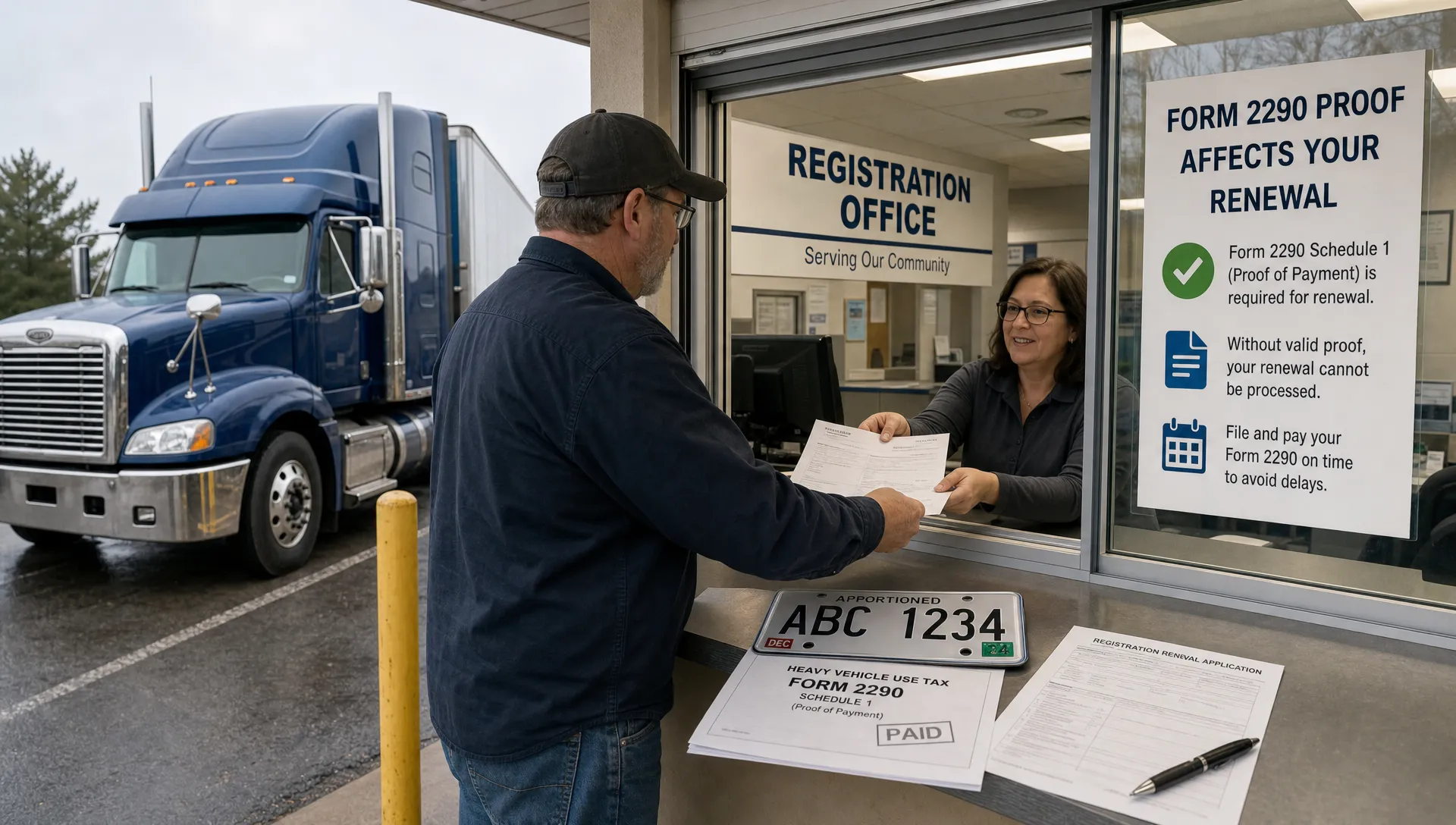
Yes, late filing can affect registration. The IRS does not issue your license plates, but state motor vehicle departments and IRP offices often ask for a stamped Schedule 1 before renewing registration for taxable heavy vehicles.
Without a current Form 2290 Schedule 1, your registration renewal may be delayed. That can lead to downtime, missed loads and extra stress at the worst possible time. For owner-operators, even a short delay can hurt cash flow. For fleets, one missing proof document can disrupt dispatch planning.
The Federal Motor Carrier Safety Administration (FMCSA) is separate from the IRS, but trucking compliance works as a chain. Tax filing, state registration, insurance, DOT requirements and operating authority all need to stay current so the truck can legally stay on the road.
Are There Exceptions to Form 2290 Late Filing Penalties?
The IRS may consider penalty relief if you had reasonable cause and the late filing was not due to willful neglect. Reasonable cause is reviewed case by case. Examples may include serious illness, natural disaster, unavoidable record loss or other events outside your control.
If you receive a Form 2290 penalty notice, read it carefully before paying or disputing it. The notice should explain what the IRS believes is late, how the amount was calculated and what you can do next. Keep copies of your e-file confirmation, payment proof, registration records and any documents that support your explanation.
A few situations are worth separating from late filing:
- If the vehicle was sold, destroyed or stolen, you may qualify for a credit or refund process.
- If a suspended vehicle later exceeds the mileage limit, additional tax may be due.
- If you overpaid HVUT, Form 8849 may apply for certain refund claims.
- If you filed with an incorrect VIN, you may need a VIN correction instead of a new return.
Penalty relief is not automatic. Filing as soon as possible gives you a better paper trail than ignoring the notice or waiting until registration renewal is blocked.
How to Avoid Missing the Form 2290 Deadline
The easiest way to avoid IRS trouble is to treat HVUT like a recurring business task, not a once-a-year surprise. Set reminders before the last day to file 2290 and keep your truck records in one place.
For a new truck, the Form 2290 due date is the last day of the month after the month the vehicle first goes on public highways. That rule catches many drivers because the deadline is not always August 31.
Good habits help:
- Save your EIN and business details where your dispatcher, tax preparer or office manager can find them.
- Check VINs against registration documents before filing.
- Track first-used month for every truck added to your fleet.
- Keep payment confirmation with your stamped Schedule 1.
- Use an IRS-authorized e-file provider instead of waiting on mailed forms.
For fleets, treating the last day to file 2290 as a dispatch compliance date can prevent small tax tasks from becoming expensive operational problems. If you manage multiple trucks, a guided online portal and fleet dashboard can make it easier to keep filings organized.
Frequently Asked Questions About Late Form 2290 Filing
What is the last day to file 2290?
For vehicles first used in July, the usual deadline is August 31. If the truck is first used in another month, the deadline is the last day of the following month. Weekends and legal holidays move the deadline to the next business day.
What should I do first after a missed Form 2290 deadline?
File the return as soon as possible, pay any HVUT due and save your acceptance proof. Waiting usually increases penalties, interest and registration risk.
When to file 2290 for 2026?
For the 2026 tax period, vehicles first used in July 2026 should be filed by August 31, 2026. A truck first used after July follows the last-day-of-the-next-month rule.
Do I have to file 2290 every year?
In most cases, yes. If you operate a taxable heavy highway vehicle with a taxable gross weight of 55,000 pounds or more, Form 2290 is generally filed annually for each tax period.
What is the last day to pay 2290?
The payment is due on the same date as the filing deadline for that vehicle. Filing without paying can still lead to penalties and interest.
How much does it cost to file your 2290?
Your IRS HVUT amount depends on the vehicle’s taxable gross weight, first-used month and whether the vehicle is suspended. E-file service fees vary by provider, so check the current price before submitting.
Can late filing stop me from renewing plates?
It can. Many DMV and IRP offices ask for stamped Schedule 1 proof before processing registration renewal for heavy highway vehicles.
Can the IRS waive penalties?
The IRS may waive penalties for reasonable cause, but you must provide a clear explanation and supporting records. Relief is not guaranteed.
File Late, But File Correctly
Missing the deadline is frustrating, but it is fixable. The key is to submit the return with the correct first-used month, pay any tax due and keep your stamped Schedule 1 ready for registration.
Simple Form 2290 helps truckers and fleet owners complete HVUT filing through an IRS-authorized online platform with a guided process, secure data handling, bulk vehicle support and customer support in English and Spanish. If the deadline has already passed, getting the filing done now is the smartest next step.
File Form 2290 Online Now