

02-04-2026
Food Truck Taxes and Form 2290: Who Must File and Who Is Exempt?


Food Truck Taxes can feel deceptively simple at first: collect sales tax, track tips, write off propane, and keep the books clean. But as soon as a food truck business adds heavier vehicles (a support truck, a refrigerated box truck, a tractor-trailer for events, or a bulk commissary rig), IRS Form 2290 (HVUT) can become a make-or-break compliance item because it impacts your ability to register and operate.
This guide breaks down who must file Form 2290, who is exempt, and what “exempt” really means in the eyes of the IRS and state registration offices.
Where Form 2290 fits inside food truck tax filing
Most taxes for food trucks are business taxes (income tax, self-employment tax, payroll tax, sales tax, local permits). Form 2290 is different: it is a federal excise tax return used to report and pay the Heavy Highway Vehicle Use Tax (HVUT).
You generally deal with Form 2290 only if you have a heavy highway motor vehicle that is:
- Registered (or required to be registered) in your name, business name, or another name, and
- Has a taxable gross weight of 55,000 pounds or more, and
- Is used on public highways during the tax period.
The key operational point for food truck operators: Form 2290 produces a stamped Form 2290 Schedule 1, which is commonly required to renew tags or complete Form 2290 and IRP registration steps for heavier vehicles.
For IRS background, see the official IRS page: About Form 2290.
Who must file Form 2290 in a food truck business
Food trucks themselves are often well under 55,000 pounds. The Form 2290 issue usually appears when the business expands into heavier, highway-driven equipment.
Step 1: Identify which vehicles you own or register
Food truck businesses commonly operate more than one vehicle type:
- The food truck (step van, box truck conversion)
- A support vehicle (pickup, cargo van)
- A tow vehicle plus trailer (events and catering)
- A heavy box truck (commissary runs, multi-unit restocking)
Form 2290 applies vehicle by vehicle, based on each vehicle’s taxable gross weight.
Step 2: Confirm the taxable gross weight (the number that drives HVUT)
The IRS taxable gross weight concept is not just the empty weight. It generally includes the vehicle, any trailers customarily used with it, and the maximum load. If you are unsure, confirm with your registration paperwork or your fleet documentation before filing.
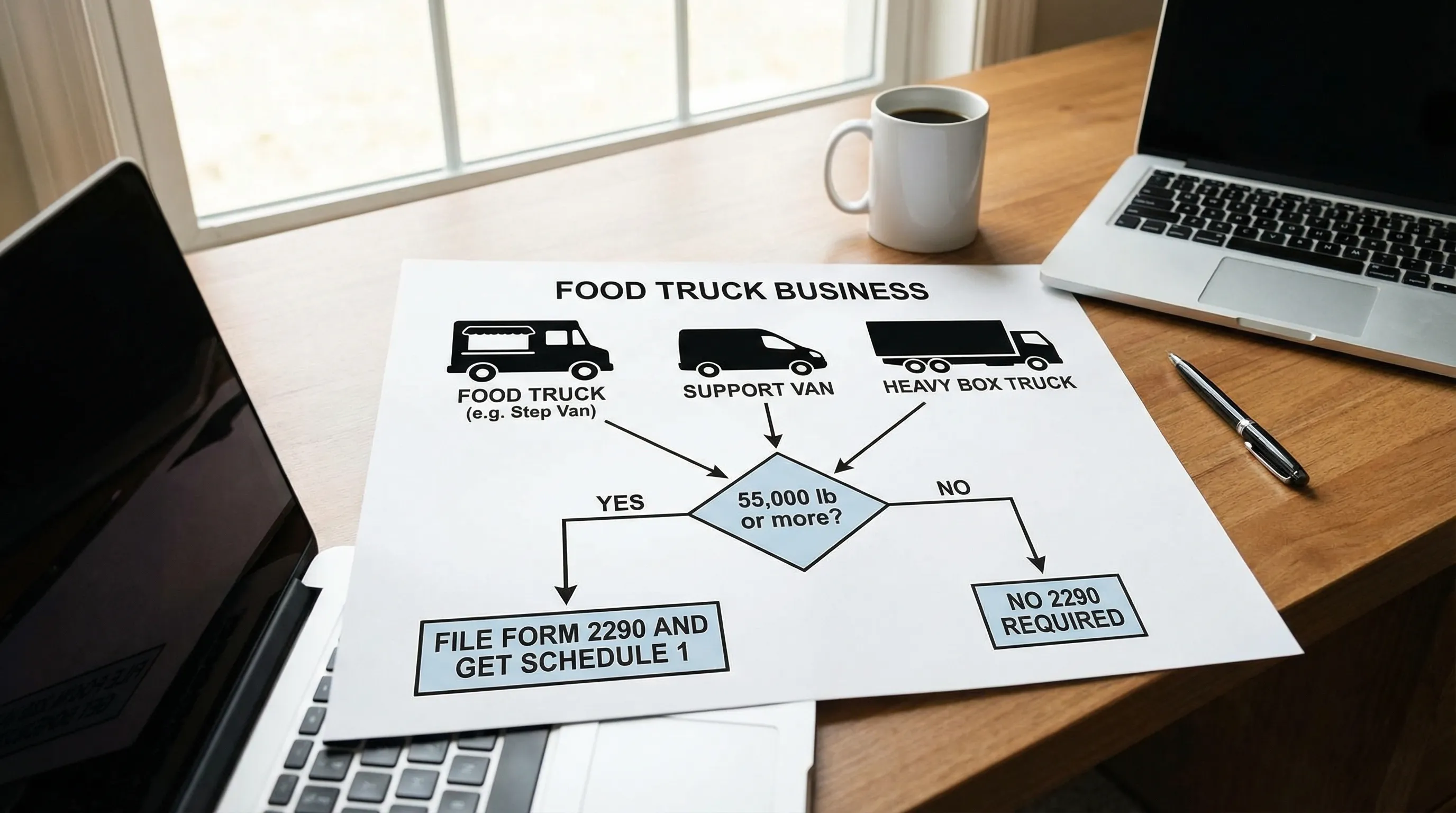
Step 3: Use the 55,000-pound trigger
If the vehicle’s taxable gross weight is 55,000 pounds or more, you likely must file Form 2290 for that vehicle.
Below is a practical tax snapshot for planning purposes (the structure is consistent, but always verify the current tax year amounts with IRS instructions):
| Taxable gross weight | Typical HVUT structure (planning view) | What it means for a food truck operator |
|---|---|---|
| Under 55,000 lb | Not subject to HVUT | No Form 2290 requirement for that vehicle |
| 55,000 to 75,000 lb | $100 + $22 per 1,000 lb over 55,000 | HVUT applies, often relevant for heavier straight trucks |
| Over 75,000 lb | Capped at $550 | Common for tractors or very heavy rigs |
A quick “must file?” decision chart
Use this quick check for any vehicle in your operation:
| Question | If YES | If NO |
|---|---|---|
| Is the vehicle’s taxable gross weight 55,000 lb or more? | Continue | Form 2290 not required for that vehicle |
| Is it registered (or required to be registered) and used on public highways? | Continue | Likely not subject for this period |
| Is it a government/nonprofit/mobile machinery exemption category? | May be exempt from tax (still often requires filing) | File and pay if taxable |
Who is exempt (and who is “suspended”) for Form 2290
In food truck tax filing, there are two big categories people lump together as “exempt,” but they behave differently.
1) Under 55,000 pounds (no HVUT requirement)
If your food truck and all business vehicles are under 55,000 pounds, Form 2290 generally does not apply. This is the most common situation for single-unit food trucks.
Important: this is not a “special exemption,” it is simply outside HVUT scope.
2) Suspended vehicles (Category W): you may still have to file
A vehicle can be tax-suspended (often called “exempt” in casual conversation) if it is expected to run under the IRS mileage threshold during the period (commonly 5,000 miles for most highway vehicles, with a higher threshold for agricultural use).
The strategic catch: a suspended vehicle still generally requires filing Form 2290 to report the suspension and obtain the correct Schedule 1 status.
If your food truck brand owns a heavy vehicle that only moves a few times per year (for example, a heavy show rig used for festivals), suspension rules can matter.
For more context on suspended filings, see: How to File Form 2290 for Suspended Vehicles.
3) True exemption categories (limited relevance for most food truck owners)
Some vehicles are exempt due to ownership or design (for example certain government vehicles or specially designed mobile machinery). These are less common in typical food truck operations, but they come up in municipal concessions or nonprofit partnerships.
Real-world food truck scenarios (what actually triggers Form 2290)
Instead of generic rules, here are practical scenarios that mirror how food truck businesses scale. These are examples for education, confirm your own weights and registration details.
| Scenario | Vehicle setup | Likely Form 2290 outcome | Why it matters |
|---|---|---|---|
| Single-truck operator | One converted step van or small box truck | Usually does not file | Often under 55,000 lb |
| Multi-truck brand with commissary runs | Food truck plus medium box truck | Depends on weight | The support vehicle may be the one that triggers HVUT |
| Festival-focused operator | Heavy rig used seasonally | May file as suspended (Category W) | Low mileage does not always mean “no filing” |
| Expansion into regional catering | Tractor plus trailer or very heavy straight truck | Must file and pay (most cases) | Often over 75,000 lb and needs Schedule 1 for registration |
The operational lesson: Form 2290 risk usually enters the picture through the “non-food-truck” vehicles that support a growing operation.
Form 2290 Schedule 1 and IRP truck registration (the compliance chain)
If you operate heavier vehicles across state lines, you may deal with irp truck registration (International Registration Plan). While IRP and HVUT are separate systems, they connect operationally:
- Many jurisdictions require proof of HVUT payment in the form of an IRS-stamped Form 2290 schedule 1.
- A mismatch in your vehicle identification number (VIN) between your registration and your 2290 filing can cause delays when you are trying to renew or apportion plates.
If IRP applies in your operation, it helps to treat 2290 as a prerequisite document, not an afterthought. See related guidance: What Is IRP Registration and Why Do Truckers Need It?.
Strategy and trends: why this matters more for food trucks in 2026
Food trucks have matured from “one truck, one route” into multi-unit operations that look more like logistics businesses:
- Brands add commissary distribution, catering, and festival travel.
- Growth often means adding heavier vehicles that cross state lines.
- Downtime from missing documentation has a real cost, especially during peak event seasons.
From a financing and growth standpoint, clean compliance is also a credibility signal. When expanding, buyers, lenders, and partners often ask for documentation that supports uninterrupted operations. For heavy vehicles, Schedule 1 is part of that paper trail.
Practical filing advice (to avoid costly downtime)
Know your trigger dates
Form 2290 is tied to a July 1 to June 30 tax period, and deadlines depend on the vehicle’s first use month. If you want to plan your season, bookmark: Form 2290 Due Dates.
Treat VIN accuracy like a “no-compromise” item
A single character error in the VIN can derail acceptance and create tag renewal delays. If you ever need to fix it, a VIN correction process exists: How to do VIN Correction.
E-file is the operationally smart default
Paper filing can introduce weeks of timing risk, which is hard to justify when you are trying to keep trucks rolling. Using an IRS Authorized E-file Provider helps you receive the stamped Schedule 1 faster and reduces common filing errors.
If you are filing for fleets, also remember: the IRS has historically required e-filing when reporting many vehicles (commonly 25 or more), which is another reason multi-unit operators build e-filing into their standard process.
Frequently Asked Questions
Do food trucks have to file Form 2290? Most food trucks do not, because many are under the 55,000-pound taxable gross weight threshold. If your business owns or registers a heavy vehicle at or above 55,000 pounds, Form 2290 may apply.
What does Form 2290 have to do with Food Truck Taxes? Food Truck Taxes include many categories, but Form 2290 is specific to federal HVUT for heavy highway vehicles. It becomes relevant when your business operates heavier trucks, tractors, or certain rigs used on public highways.
What is Form 2290 Schedule 1 and why do I need it? Form 2290 Schedule 1 is the IRS-stamped proof that your HVUT filing was accepted (and tax paid or properly reported). It is often required for registration renewals and can be important for Form 2290 and IRP registration workflows.
If my heavy vehicle is low-mileage, am I exempt from filing? You may be able to claim a suspended (low-mileage) status, but you often still must file Form 2290 to report the suspension and receive the correct Schedule 1.
Which vehicle information is most important when filing? Your EIN, first-used month, taxable gross weight category, and the vehicle identification number (VIN). VIN accuracy is critical to avoid delays.
File Form 2290 the fast way with Simple Form 2290
If your food truck business has a heavy vehicle that triggers HVUT, the goal is simple: file accurately and get your stamped Schedule 1 quickly so registration is not delayed.
Simple Form 2290 is an IRS-authorized platform designed to make Form 2290 filing fast and straightforward, with a guided process, secure data handling, bulk filing options for fleets, and bilingual (English/Spanish) support.
Start your Form 2290 filing here: Simple Form 2290 or review the walkthrough: How to eFile Form 2290 with Simple Form 2290.