
 requirements.&p[url]=https://www.simpleform2290.com/blog/used-truck-vs-new-truck-owner-operators&p[images][0]=https://www.simpleform2290.comhttps://simpleform2290.com/blog_image/Used Truck vs New Truck.jpg)

The Real Question Owner-Operators Are Asking
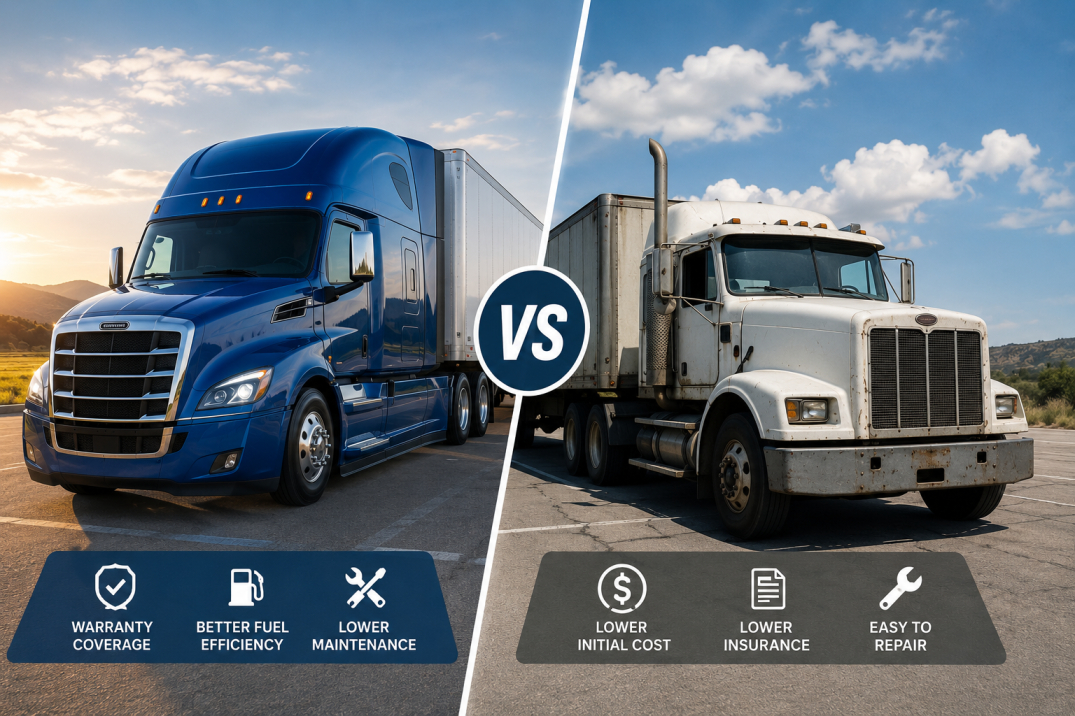
The used truck vs new truck debate comes down to three things for most owner-operators: upfront cost, operating cost over time, and compliance headaches. New trucks cost more to buy but less to maintain in the early years. Used trucks cost less upfront but may carry higher repair bills, more downtime risk, and less predictable fuel economy.
Neither is universally better. The right answer depends on your cash position, your credit, how many miles you run annually, and whether you prefer the certainty of a warranty or the flexibility of lower monthly payments. This guide covers all of it, and it also covers the Form 2290 rules that apply the moment you drive either truck on a public highway, because that part catches a lot of new owner-operators off guard.
New vs Used Truck Pros Cons 2026
Here is the honest breakdown of both sides of the new truck vs used truck decision as it stands heading into 2026. Used truck prices have remained elevated relative to historical norms because of persistent new truck supply constraints and high fleet demand. That changes some of the traditional math.
New Truck: Pros
- Full manufacturer warranty, typically 2 years bumper to bumper
- Latest emissions compliance, no DEF surprises
- Better fuel economy on newer engine platforms
- Lower maintenance cost in first 250,000 miles
- Easier to finance at competitive rates
- Predictable operating costs early in ownership
New Truck: Cons
- $150,000+ purchase price, steep monthly payments
- Significant depreciation in first 3 years
- Complex electronics add dealer repair dependency
- Longer wait times due to order backlogs
- Full prorated HVUT owed from month of purchase
Used Truck: Pros
- Lower purchase price, less debt burden per mile
- Depreciation already absorbed by prior owner
- HVUT may already be paid for the current tax year
- Easier to pay cash or put larger down payment
- More room to negotiate on price
- Availability is faster than new order lead times
Used Truck: Cons
- Higher repair and maintenance costs over time
- No warranty on most private or dealer used sales
- Uncertain maintenance history on some units
- Older emissions equipment may need costly repairs
- Higher interest rates typical on used truck loans
New Truck vs Used Truck: Side by Side
| Factor | New Truck | Used Truck |
|---|---|---|
| Purchase Price | $150,000 to $200,000+ | $40,000 to $110,000 |
| Monthly Payment | $2,500 to $4,000 typical | $900 to $2,200 typical |
| Warranty | Full manufacturer coverage | Usually none or limited extended |
| Depreciation | Heaviest in first 3 years | Already taken by prior owner |
| Fuel Economy | 8 to 10+ mpg on modern engines | 6 to 8 mpg on older platforms |
| Maintenance Cost | Low first 2 to 3 years | Higher, varies by age and miles |
| Form 2290 Required | Yes, from first use month | Yes, unless prior owner paid current year |
| HVUT Proration | Prorated from first-use month | Prorated if prior HVUT not paid |
| Availability | 4 to 12 month order lead time | Immediate in most markets |
Form 2290 Rules When You Buy a New or Used Truck
This is the section most buyers skip and then scramble over later. The moment your truck first rolls onto a public highway, the IRS Form 2290 clock starts. The new vs used truck distinction matters here because it changes whether you owe a full year, a prorated amount, or nothing until the next tax cycle starts.
Buying a New Truck
When you buy a new truck, you are the first owner and no HVUT has ever been paid on that vehicle. You must file Form 2290 and pay the prorated HVUT by the last day of the month following the month your truck first went on a public highway. The IRS Form 2290 for 2026 covers the tax year July 1, 2026 through June 30, 2027.
If you buy a new truck in October 2026 and drive it for the first time that month, your Form 2290 is due by November 30, 2026. The tax is prorated based on the months remaining in the tax year. October through June is nine months, so you pay nine-twelfths of the annual rate. Use the HVUT tax calculator to get the exact prorated figure before filing.
Buying a Used Truck
A used truck purchase has one extra variable: whether the previous owner already paid the HVUT for the current tax year. This is the most common source of confusion in the new truck vs used truck compliance picture.
Two scenarios apply when you buy a used truck mid-year:
- Prior owner paid the HVUT for the current tax year: If the seller has a valid stamped Schedule 1 covering the current July 1 to June 30 period, the HVUT for that year is considered paid. You do not owe tax again until the next annual cycle begins on July 1. Ask to see the prior Schedule 1 before finalizing the purchase. Always verify the VIN on the Schedule 1 matches the truck you are buying.
- Prior owner did not pay or paid for a different period: If no valid Schedule 1 exists for the current tax year, you are responsible for filing Form 2290 and paying the prorated HVUT from the month you first drive the truck on a public road. The deadline is the last day of the month following your first-use month.
- Suspended vehicle from prior owner: If the prior owner filed a suspended return (low-mileage exemption), you need your own Form 2290 filing because the suspended status does not automatically transfer to a new owner with different operating patterns.
When Is Form 2290 Due for 2026?
The IRS 2290 form 2026 tax year runs July 1, 2026 through June 30, 2027. Regardless of whether you are buying a new truck or a used truck, the filing deadline depends entirely on the first-use month.
For IRS 2290 payment, the tax is due at the same time as the filing. E-filing through SimpleForm2290 lets you pay via Electronic Funds Withdrawal directly from your bank account, EFTPS, or a check with Form 2290-V mailed separately.
Can You Transfer Form 2290 from One Truck to Another?
No. You cannot transfer a Form 2290 HVUT payment from a truck you sold or traded in to your new or replacement truck. Each vehicle has its own VIN, and the IRS ties HVUT payments to specific VINs. When you replace a truck, you need a fresh Form 2290 filing for the new vehicle.
If you sell or retire a truck that still has months remaining in its tax year, you can claim a credit for the unused portion using IRS Form 8849. That credit can be applied against the HVUT you owe on your new or replacement truck. It does not transfer automatically; you have to file for it.
-
File Form 2290 for the replacement truck Submit a new return with the new VIN, taxable gross weight, and the first-use month for the replacement vehicle. This is due by the last day of the month after you first drive the new truck.
-
Claim your credit on Form 8849 for the sold truck File Schedule 6 of Form 8849 to request a refund or credit for the months remaining on the truck you sold or took off the road. Include the VIN of the old truck, the date it was sold or destroyed, and the original tax paid.
-
Apply the credit to reduce what you owe on the new truck If you prefer, you can apply the Form 8849 credit toward the HVUT liability on your new truck filing rather than receiving a cash refund. This reduces your out-of-pocket payment at the time of the new filing.
Just Bought a Truck? File Form 2290 and Get Your Schedule 1 Today.
SimpleForm2290 is IRS-authorized. Whether it is a new truck or used truck purchase, file your HVUT return online in minutes and receive your stamped Schedule 1 the same day. Plans from $9.95. Use code HVUT20 for 20% off.
File Form 2290 Now How It WorksWhat to Look for When Shopping: Cheapest New Truck and Best Used Truck Options
For owner-operators watching cash flow, the cheapest new truck in the Class 8 segment typically comes from Freightliner, Kenworth, or International on base spec configurations. As of 2026, day cab configurations with a standard 13-speed transmission and a mid-range horsepower engine come in at the lower end of the new truck price range, though "lower end" still means well over $120,000. Dealer incentive programs and fleet discount programs may reduce that figure for qualified buyers.
The best used truck for an owner-operator is harder to define because condition, history, and spec matter more than brand. That said, trucks in the 500,000 to 700,000 mile range with verifiable oil change and DPF service records, clean titles, and recent major service tend to give the best value per dollar spent. At that mileage, prior depreciation has already hammered the price, but a well-maintained engine has plenty of life left. The 100,000-mile concern people have about used trucks applies much more to pickup trucks than to Class 8 diesels built for multi-million-mile service lives.
Form 2290 Instructions for New and Used Truck Buyers
The Form 2290 instructions for both new and used truck filings are the same document. The IRS publishes Form 2290 instructions for each tax year that cover every scenario including prorated filings, suspended vehicles, VIN corrections, and credit claims.
For a new truck purchase, the key fields are your EIN, the truck's VIN, the taxable gross weight category, and the first-use month. For a used truck where the prior HVUT was not paid, the same fields apply. The only difference is that used truck buyers should also have the prior Schedule 1 on hand to confirm whether they owe anything at all for the current period.
If you prefer to review the Form 2290 PDF before e-filing, the IRS publishes the official form at irs.gov. For faster processing and same-day Schedule 1 delivery, e-filing through SimpleForm2290 is the better path for both new truck and used truck situations. The form 2290 new truck pdf filing process and the used truck filing process are identical through an e-file provider; you just select the correct first-use month for your situation.
Understanding how to fill out Form 2290 new truck filings is straightforward once you have your EIN, the VIN from the door jamb or title, and the taxable gross weight category. The same fields apply when completing form 2290 when you buy a used truck, with the added step of confirming whether the prior owner's Schedule 1 is still valid for the current tax period. The used truck vs new truck difference in the filing itself is only the first-use month you enter, everything else on the form is the same.
In the used truck vs new truck decision overall, the compliance picture is not a meaningful differentiator. Both require a Form 2290 filing. Both require a stamped Schedule 1 before the DMV will register the vehicle. The timing and prorated amount differ, but the process is the same. Where used truck vs new truck really separates is in your monthly cash commitment and your exposure to repair costs over the first three years of ownership.
Related Resources
Frequently Asked Questions
You must file Form 2290 by the last day of the month following the month your truck was first driven on a public highway. For example, if you buy a truck and drive it for the first time in September 2026, your Form 2290 is due by October 31, 2026. The tax is prorated based on the months remaining in the July 1 to June 30 tax year. For used trucks, check whether the prior owner already paid the HVUT for the current period before assuming you owe anything right away.
No. Form 2290 HVUT payments are tied to specific VINs and cannot be transferred between vehicles. When you replace a truck, you must file a new Form 2290 for the new vehicle. You can file IRS Form 8849 to claim a credit for unused months on the vehicle you sold or retired, and that credit can be applied to offset the HVUT owed on the replacement truck.
No, not for a commercial Class 8 truck. Heavy-duty diesel engines are engineered to run well past one million miles when properly maintained. A used truck with 100,000 miles is essentially broken in. What matters far more than mileage is the maintenance history: documented oil changes, DPF cleaning intervals, coolant flush records, and whether the turbo, injectors, and EGR components have been serviced. A truck at 600,000 miles with full service records is often a better buy than one at 200,000 miles with no paperwork.
Used truck prices have stayed elevated because new truck production has faced ongoing supply constraints from semiconductor shortages and extended order backlogs. When new trucks are hard to get, buyers turn to the used market, which drives used prices up. In 2025 and into 2026, Class 8 used truck values have remained higher than historical averages. The new vs used truck price gap has narrowed significantly compared to where it stood five years ago, which makes the used truck value proposition less automatic than it used to be.
The $3,000 rule is a general consumer guideline suggesting you avoid buying a used vehicle if the estimated repair cost to make it roadworthy exceeds $3,000, or if annual repair costs exceed that threshold relative to the vehicle's value. It originates from personal vehicle buying advice and is not an IRS or trucking industry regulation. For commercial trucks, the calculus is different because repair costs are higher, the vehicles are more valuable, and downtime cost matters as much as the repair bill itself. Most owner-operators evaluate used truck purchases on total cost of ownership over two to three years rather than a single dollar threshold.
Not necessarily. You need to verify whether the prior owner filed Form 2290 and paid the HVUT for the current July 1 to June 30 tax year. Ask for a copy of the stamped Schedule 1 and confirm the tax period dates and VIN match the truck you are buying. If the prior HVUT was paid and the period is still current, you do not owe again until the next annual cycle. If no valid Schedule 1 exists for the current period, you must file Form 2290 and pay the prorated tax from your first-use month.
For the 2026-2027 HVUT tax year, the primary Form 2290 due date is August 31, 2026, for vehicles first used in July. Trucks purchased and first driven in later months file by the last day of the following month. E-filing with an IRS-authorized provider like SimpleForm2290 opens July 1, 2026, and delivers your stamped Schedule 1 the same day the IRS accepts the return.
New Truck or Used Truck, Your Form 2290 Is Due Once It Hits the Road
File your HVUT return online with SimpleForm2290. IRS-authorized, starts at $9.95, same-day Schedule 1. Use code HVUT20 for 20% off.
File Now See Pricing