
02-24-2026
What Is Gross Vehicle Weight? A Simple Guide for Truck Owners
 means, how it differs from GVWR, and why it matters for truck safety, compliance, and Form 2290 tax filing. Truck owners will learn how GVW is measured, where to find accurate weight information, and how improper weight reporting can lead to penalties. Clear, practical insights help avoid costly mistakes and ensure regulatory compliance.&p[url]=https://www.simpleform2290.com/blog/what-is-gross-vehicle-weight-guide&p[images][0]=https://www.simpleform2290.comhttps://simpleform2290.com/blog_image/what-is-gross-vehicle-weight-a-simple-guide.webp)

If you own a heavy truck, “weight” is not just a number on a door sticker. It influences safety, roadside enforcement, permits, load planning, and for many operators, whether you must file IRS Form 2290 and how much Heavy Vehicle Use Tax (HVUT) you owe. The confusing part is that the industry uses similar terms (GVW, GVWR, GCWR, taxable gross weight) interchangeably, even though they mean different things and are used by different agencies for different decisions.
This simple guide explains gross vehicle weight in plain English, shows how it differs from IRS taxable gross weight, and gives practical, strategy-focused advice to avoid expensive filing errors and registration delays.
Gross Vehicle Weight (GVW): the simplest definition
Gross Vehicle Weight (GVW) is the actual weight of your truck at a specific moment in time.
It typically includes:
- The truck (tractor) itself
- Driver and passengers
- Fuel and fluids
- Any permanently attached equipment (toolboxes, racks, installed accessories)
- Cargo currently on the truck
Because fuel level, payload, and even add-on equipment change, GVW changes trip to trip. That is why GVW is best treated as an operational metric, not a fixed spec.
GVW vs GVWR vs GCWR (and why the mix-up costs money)
Truck owners often blend “what I weigh today” with “what I am rated for” and “what the IRS taxes.” The clean separation below is one of the easiest ways to prevent mistakes.
| Term | What it means | Scale weight? | Practical use case |
|---|---|---|---|
| GVW (Gross Vehicle Weight) | Actual weight of the truck right now | Yes | Weigh stations, load safety, real-world operations |
| GVWR (Gross Vehicle Weight Rating) | Max safe weight the manufacturer allows for the vehicle | No (it is a rating) | Specs, compliance rules tied to ratings, safety margins |
| GCW (Gross Combination Weight) | Actual weight of truck plus trailer(s) right now | Yes | Combination enforcement, route planning, axle distribution |
| GCWR (Gross Combination Weight Rating) | Max combined weight the manufacturer allows | No (it is a rating) | Powertrain/axle limits, safe combination operations |
A simple memory trick:
- W = Weight (what you actually weigh today)
- WR = Weight Rating (what the unit is allowed to weigh)
For general commercial vehicle terminology and regulatory context, the FMCSA is a reliable starting point.
Where do you find your GVW?
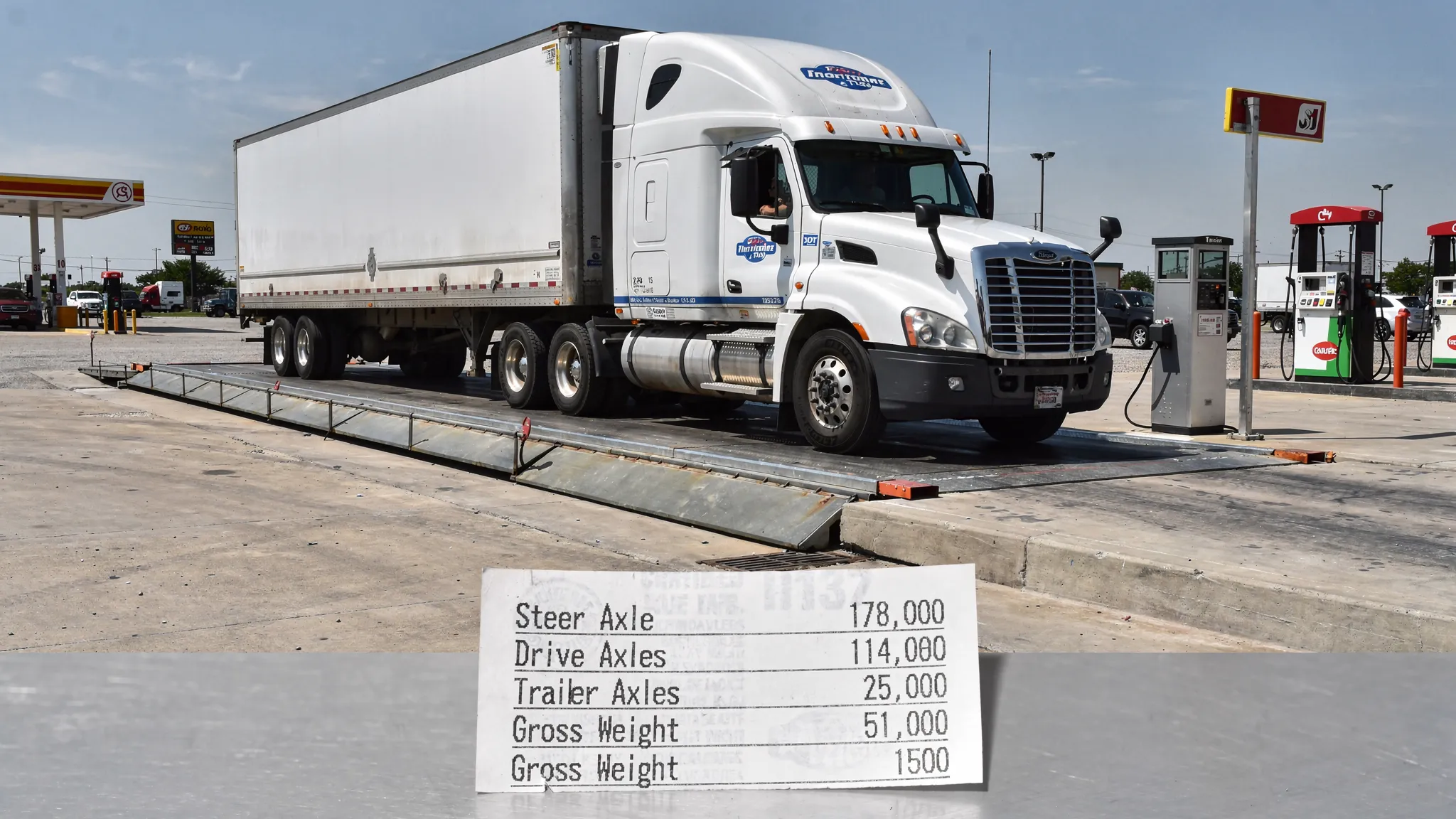
Because GVW is “real-time,” the best way to know it is to weigh the vehicle.
Common places truckers get a weight ticket:
- Certified truck scales (including CAT scales)
- Co-op fuel stops with scales
- Quarry, grain elevator, shipper/receiver scales
- Some terminals and yards
The strategic takeaway is this: a door sticker can tell you the rating (GVWR), but only a scale ticket tells you what you weigh right now, which is what enforcement and load planning care about.
Where do you find GVWR and other ratings?
GVWR and related ratings are set by the manufacturer. Depending on your unit, you will usually find them in one of these spots:
| What you need | Typical place to find it | Notes |
|---|---|---|
| GVWR | Door jamb label (many trucks) or manufacturer data plate | Often labeled “GVWR” directly |
| GAWR (axle ratings) | Same label/data plate | Key for axle legality and tire limits |
| Trailer GVWR | Trailer VIN/data plate | Especially relevant if you run a consistent trailer |
| Actual weights | Scale ticket | Best proof of real operating weight |
If you are unsure, your dealer or manufacturer can usually confirm ratings using your vehicle identification number (VIN).
“Gross vehicle weight by VIN”: what you can (and cannot) learn
Many owners search gross vehicle weight by VIN when buying a used truck, onboarding a lease operator, or updating paperwork. The VIN can help you look up manufacturer ratings (like GVWR) and original configuration data.
What it usually does not give you is your GVW, because GVW depends on current fuel, equipment, driver, and cargo. Think of VIN-based lookup as a way to confirm what the truck is built to handle, while the scale tells you what you are actually doing today.
The Form 2290 connection: GVW is not the same as taxable gross weight
When truckers say “weight for 2290,” they usually mean taxable gross weight, not GVW.
For IRS Form 2290 (HVUT), you generally file and pay based on:
- Taxable gross weight, and
- The month the vehicle was first used on public highways during the tax period
The IRS definitions and method are described in the official IRS Form 2290 instructions.
What is taxable gross weight (in plain English)?
Taxable gross weight is based on a combination of:
- The unloaded weight of the power unit (fully equipped for service)
- The unloaded weight of trailers (or semitrailers) typically used with it
- The weight of the maximum load customarily carried
This is why two similar gross vehicle weight trucks can land in different 2290 weight categories if they are used differently.
The big threshold: 55,000 pounds
In general, Form 2290 applies when a vehicle has a taxable gross weight of 55,000 pounds or more.
If you want a quick refresher on who must file (including common edge cases), see: Who must file Form 2290.
Market reality: why weight compliance is getting less forgiving
Weight accuracy is not just “doing paperwork right.” It is risk management.
Two forces are pushing operators toward cleaner documentation and more consistent weight decisions:
- Electronic systems and cross-checks: Many state registration systems depend on quick validation of Form 2290 proof. The faster your IRS-stamped Schedule 1 is produced and matches your registration facts, the less time you spend stuck in exceptions.
- Thin margins: When rates soften, small compliance errors become more painful. Overpaying HVUT on a fleet, paying penalties, or losing time at renewal is a real profit leak.
You do not need to treat this as a legal thesis. Treat it like dispatch: get the inputs right, document them once, and update them when operations change.
A quick visual: how these weights relate
The relationships below help new owners avoid the most common mental trap (assuming a single scale ticket equals the IRS category).
| Weight type | How it changes | Best “source of truth” | What it impacts |
|---|---|---|---|
| GVW / GCW | Changes constantly | Scale ticket | Roadside enforcement, loading, axle distribution |
| GVWR / GCWR | Fixed rating | Manufacturer label, VIN lookup | Safe operating limits, some regulatory classifications |
| Taxable gross weight (Form 2290) | Changes when your “customary” setup changes | Your documented typical configuration + IRS rules | HVUT amount, Form 2290 Schedule 1 proof |
How to estimate taxable gross weight for Form 2290 (without guesswork)
If you are selecting the right gross vehicle weight for trucks category for HVUT filing, the goal is to match how the vehicle is customarily operated on public highways.
A practical approach:
- Start with the power unit’s unloaded, fully equipped weight.
- Add the unloaded weight of the trailer(s) you customarily use.
- Add the maximum load you customarily carry.
- Use the IRS method and weight category rules in the Form 2290 instructions.
If you want the tax calculation angle, see: How to calculate HVUT tax for Form 2290.
Lessons learned: where owners and fleets get weight wrong
The most expensive mistakes tend to happen in transition moments (new authority, used truck purchase, switching lanes, adding a heavier trailer). These are patterns that show up across owner-operators and small fleets.
Confusing GVWR with taxable gross weight
GVWR can be a helpful clue, but it is not automatically your 2290 category. The IRS cares about the customary combination and load, not the manufacturer rating alone.
Forgetting the trailer in “typical operations”
If you customarily pull a trailer, your taxable gross weight must reflect that. This is especially common when an owner buys a tractor first, then later starts pulling a heavier setup but never updates the filing logic.
Not filing after a weight increase
If your taxable gross weight goes up during the tax year, you generally need a weight increase amendment and to pay additional HVUT for the remaining months. Here is a walk-through: How to update Form 2290 for an increase in gross weight.
Treating “close enough” as a strategy
A “best guess” might feel harmless for one truck. Multiply it across a small fleet and the dollars add up quickly, either through overpayment or amendments and delays.
Form 2290 and IRP: why Schedule 1 accuracy affects registration speed
Many operators experience weight pain when they hit renewal or add a unit mid-year. This is where Form 2290 and IRP registration meet.
IRP (International Registration Plan) offices and DMVs typically want proof of HVUT payment, commonly your Form 2290 Schedule 1 (IRS-stamped). If the taxable gross weight or VIN data on your filing does not align with your registration facts, it can slow down your irp truck registration timeline.
If you need a practical overview of the proof document itself, read: Schedule 1 Form 2290: What you need to know.
Strategic tip for fleets and owner-operators
Create a simple internal “weight profile” for each unit:
- Power unit (VIN, configuration)
- Typical trailer used
- Typical max load customarily carried
- Taxable gross weight category used on Form 2290
- Notes on when operations changed
This reduces rework when you are under pressure (renewals, audits, adding drivers), and it makes your Schedule 1 easier to reproduce consistently.
Example: GVW vs taxable gross weight
Imagine a tractor-trailer combo that weighs 72,800 lbs on a scale today.
- Today’s GVW/GCW: 72,800 lbs (actual)
- Next week’s GVW/GCW: could be 68,500 lbs with a lighter load
- Taxable gross weight (2290): based on the setup and max load the unit is customarily operated with, not just today’s ticket
This is why using a single light-load day to justify a lower Form 2290 category can backfire when your real operating pattern is heavier.
Filing choice: why an IRS Authorized E-file Provider helps
Time matters because your proof matters. When you file correctly, you receive an IRS-stamped Schedule 1 after acceptance, which is the document many registration workflows depend on.
Simple Form 2290 is an IRS Authorized E-file Provider that lets you electronic file Form 2290 and pay online. If you are trying to avoid delays tied to the schedule 1 form 2290 due window, e-filing is typically the most predictable path because it reduces mailing time and helps you move directly into the acceptance and Schedule 1 stage.
(If you are comparing options, focus less on “Best 2290 E-File Provider” hype and more on accuracy, support responsiveness, and how fast you can correct issues when the IRS rejects a return.)
Frequently Asked Questions
What is gross vehicle weight (GVW) in trucking? GVW is the actual weight of your truck at a given moment, including the vehicle, fuel, driver, equipment, and cargo.
Is GVW the same as GVWR? No. GVW is what the vehicle weighs right now. GVWR is the maximum weight rating set by the manufacturer.
Can I find gross vehicle weight by VIN? You can often use a vehicle identification number (VIN) to confirm manufacturer ratings like GVWR, but GVW is a real-time scale weight that changes with fuel, equipment, and cargo.
Does Form 2290 use GVW or GVWR? Form 2290 is based on taxable gross weight, calculated using unloaded weights plus the weight of the maximum load customarily carried (per IRS instructions). It is not simply GVW or GVWR.
How does Form 2290 Schedule 1 connect to IRP? Many DMVs and IRP offices require an IRS-stamped Schedule 1 as proof of HVUT payment for IRP truck registration. If the filing details do not match your registration facts, it can slow approval.
File Form 2290 with the right weight and get Schedule 1 fast
If you are ready to file, Simple Form 2290 helps owner-operators and fleets submit Form 2290 through an IRS-authorized e-file process and receive an IRS-stamped Form 2290 Schedule 1 after acceptance.
Start here: E-file Form 2290 online with SimpleForm2290
Meta description: Gross Vehicle Weight explained for truck owners, plus how it affects Form 2290 taxable gross weight, Schedule 1, and IRP registration with Simple Form 2290.
Our services are also available for E-File Florida Form 2290 Online, Form 2290 Texas, Form 2290 California, Form 2290 in Illinois, File Form 2290 in Georgia, File Form 2290 in Tennessee and File Form 2290 in Pennsylvania .