

02-12-2026
Form 2290 Explained: 15 Most Asked Questions by Truckers (2026 Guide)
&p[summary]=This 2026 guide explains Form 2290 in a simple, practical way by answering the 15 most common questions truckers ask. From deadlines and weight limits to Schedule 1 and penalties, it helps you file correctly, avoid costly mistakes, and stay fully compliant with IRS requirements.&p[url]=https://www.simpleform2290.com/blog/form-2290-15-truckers-top-questions-2026-guide&p[images][0]=https://www.simpleform2290.comhttps://simpleform2290.com/blog_image/form-2290-explained-15-most-asked-questions.webp)
&via=Simpletrucktax Blog&url=https://www.simpleform2290.com/blog/form-2290-15-truckers-top-questions-2026-guide&image-src=https://www.simpleform2290.comhttps://simpleform2290.com/blog_image/form-2290-explained-15-most-asked-questions.webp)
If you run a heavy truck, Form 2290 filing is not just “another tax form”, it is the gatekeeper to plates, permits, and cash flow. In 2026, the truckers who stay profitable are the ones who treat HVUT compliance like a repeatable process: clean VIN data, a simple calendar, and fast access to an IRS-stamped Schedule 1 when IRP renewal hits.
Below are the 15 questions truckers ask most, answered in plain English with strategic tips you can actually use this filing season.
A 30-second cheat sheet (what matters most)
| Item | What it means | Why you should care |
|---|---|---|
| Form 2290 (HVUT) | Federal tax return for heavy highway vehicles | Needed to stay compliant and avoid penalties |
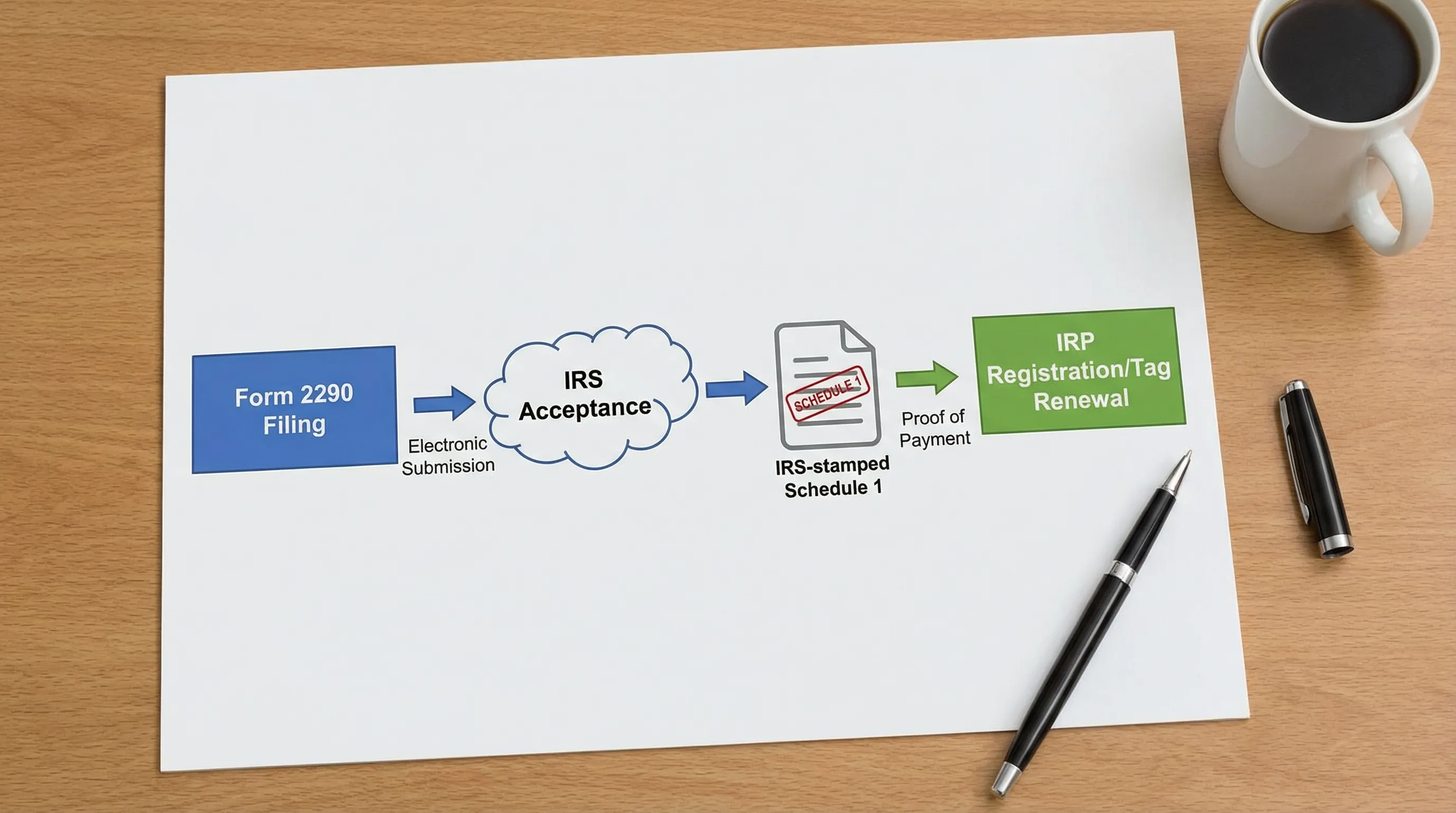
| 2290 Schedule 1 | IRS-stamped proof of filing/payment (or suspension) | Commonly required for IRP truck registration and tag renewals |
| 55,000 lbs+ | General threshold for filing | Most highway tractors fall here |
| Deadline rule | File by the last day of the month after “first use” | Miss it and you can trigger penalties and registration delays |
For official definitions and references, start with the IRS hub for Form 2290.
1) What is Form 2290, and why do truckers have to file it?
Form 2290 is the IRS return used to report and pay the Heavy Highway Vehicle Use Tax (HVUT). If your vehicle is registered (or required to be registered) for highway use and meets the weight threshold, the IRS expects a 2290 return for that tax period.
Strategic takeaway: treat HVUT as a “license to operate” cost. The real pain is rarely the tax itself, it is the downtime when you cannot produce Schedule 1 for renewals.
2) Who must file Form 2290?
In general, owners of highway motor vehicles with a taxable gross weight of 55,000 pounds or more must file. Some vehicles can be exempt or suspended, but they often still must be reported.
If you want the IRS definition details, refer to the IRS Form 2290 instructions.
3) What is “taxable gross weight” (and why it causes so many mistakes)?
Taxable gross weight is not just what your tractor scales today. It is generally based on the unloaded vehicle weight, plus unloaded trailer weight customarily used, plus the maximum load normally carried, then aligned to IRS weight categories.
Lesson learned from peak season: many rejections and amendments start with weight category confusion. If you are unsure, confirm your registration weight and how you dispatch the unit for the year.
4) What is the “First Used Month” (FUM) and how does it change my due date?
FUM is the first month the vehicle is used on public highways during the tax period. Your filing deadline is typically the last day of the month following that first-use month.
Strategic tip: for growing fleets, “first use” becomes a workflow. Every newly added truck should trigger the same checklist: VIN capture, weight category, FUM, payment method, then Schedule 1 storage.
5) When is Form 2290 due for most trucks?
For vehicles in service in July (the beginning of the HVUT tax period), the common annual deadline is August 31. If August 31 falls on a weekend or legal holiday, it shifts to the next business day.
To avoid timing surprises, use a due-date reference like the month-by-month table on Form 2290 due dates.
6) What is Form 2290 Schedule 1, and why does my IRP office ask for it?
Form 2290 Schedule 1 is the IRS-stamped schedule listing your vehicle VIN(s) and tax status. It is widely used as proof that HVUT has been filed and paid (or properly suspended), especially for Form 2290 and IRP registration workflows.
If you need a deeper breakdown of what appears on it and how states use it, see Schedule 1 Form 2290: What You Need to Know.
7) How fast can I get an IRS-stamped Schedule 1?
With e-filing, Schedule 1 can be available minutes after IRS acceptance (timing depends on IRS processing and whether your return is accepted or rejected). With paper filing, it commonly takes weeks.
This is why many truckers choose an IRS Authorized E-file Provider. With Simple Form 2290, the core value is speed and repeatability: you file online and retrieve the stamped Schedule 1 when you need it.
8) Is e-filing required, or can I still mail Form 2290?
You can still mail in some cases, but e-filing is required if you file for 25 or more vehicles in a tax period. Even below that threshold, many owners choose to electronic file Form 2290 and pay online because it reduces delays and makes reprints easier.
If you are comparing methods, this mailing guide is helpful: IRS mailing address for Form 2290.
9) What documents and info do I need before I start?
Most delays happen because one of these is missing or inconsistent:
- EIN and business name (must match IRS records)
- Vehicle Identification Number (VIN)
- Taxable gross weight category
- First Used Month
- Payment method selection
If you do not have an EIN yet, follow the process in How to apply for an EIN online for Form 2290 filing.
10) Why do Form 2290 returns get rejected?
Rejections cluster around a few predictable issues. Building a “data hygiene” habit reduces resubmits during deadline week.
| Common rejection driver | What it looks like | Prevention move |
|---|---|---|
| EIN mismatch | Business name/EIN does not match IRS records | Use the IRS-issued EIN letter, avoid typos |
| VIN error | Wrong digit, transposed characters | Copy from registration/title, double-check |
| Duplicate filing | Same VIN and period already filed | Confirm status before re-filing |
| Payment issue | Incorrect routing/account info, mismatch | Verify payment method details before submission |
If you are unsure whether the IRS accepted your return, use this guide: How to check 2290 filing status.
11) How much is the 2290 tax, and what is the maximum?
Tax depends on weight category and the month first used. The commonly cited maximum HVUT amount for vehicles over 75,000 lbs is $550 for a full tax period (non-logging).
Cash-flow lesson: if you put a truck on the road mid-year, the tax is prorated by first-used month. Good recordkeeping on in-service timing can prevent overpaying.
12) What if my truck is “suspended” (low mileage)? Do I still file?
Yes, in many cases you still file Form 2290 to report the vehicle as suspended (generally 5,000 miles or less for most vehicles, 7,500 for some agricultural use). Suspension is not “do nothing”, it is “file differently.”
Operational tip: suspension is easiest when mileage is tracked consistently. If you exceed the mileage limit later, you may need an amendment.
13) What is a taxable weight amendment, and when do I need one?
If a vehicle’s taxable gross weight increases into a higher category during the period, the IRS generally expects a Taxable Weight Amendment and payment of the additional tax for the remaining months.
For the detailed rules and when to amend, see Taxable Weight Amendments.
14) How does Form 2290 connect to IRP registration (and why it becomes a “deadline stack”)?
Many fleets experience compliance as a stack: HVUT (Form 2290) plus IRP renewals plus insurance plus state processes. If you miss HVUT timing, the domino effect can delay 2290 Schedule 1 for IRP and stall plates.
Real-world pattern: fleets that centralize documents (Schedule 1 by VIN, tax period, and status) spend less time chasing paperwork when an IRP office requests proof.
To understand the IRP side, read What is IRP registration and why do truckers need it?.
15) What is the smartest way to file if I have multiple trucks (or add trucks often)?
If you manage more than a couple of units, the strategy is consistency:
- Use bulk and fleet filing to reduce per-VIN friction
- Standardize how VINs and weights are collected (registration packet, not text messages)
- Store stamped Schedule 1s so they are searchable at audit or renewal time
That is where an “Easy 2290” workflow matters more than a one-time low price. Simple Form 2290 is built for repeat filing: guided steps, bulk filings, bilingual support (English/Spanish), and document retrieval so you are not rebuilding records every season.
A practical 2026 filing playbook (use this before deadline week)
The truckers who avoid last-minute stress usually do three things:
- Pre-validate identity data (EIN and business name match IRS records)
- Lock a VIN process (one source of truth, double-check before submitting)
- Treat Schedule 1 like a permit (download, store, and be ready to present it for IRP)
If you want a streamlined option with fast Schedule 1 delivery, file online with Simple Form 2290 (an IRS-authorized e-file provider) and keep your HVUT paperwork ready for the next IRP touchpoint.