

03-25-2026
Form 2290 Penalty for Late Filing: What Truck Owners Need to Know


Late Form 2290 happens more often than most truck owners admit, especially in peak renewal season when dispatch is busy and paperwork stacks up. The catch is that the IRS does not just want the Heavy Vehicle Use Tax (HVUT) paid, it wants the return filed on time, with a valid EIN, correct VINs, and the right first-used month. If you miss your window, the Form 2290 Penalty for Late Filing can add real cost, delay your stamped Schedule 1, and trigger downstream issues with IRP renewal and registration.
This guide breaks down how the penalty works, what “late” really means for different fleets, how costs compound, and what strategic steps reduce both penalties and operational downtime.
What “late filing” means for Form 2290 (it is not always August 31)
Many people associate Form 2290 with the annual HVUT deadline of August 31. That date matters, but it is only “the deadline” for vehicles first used on public highways in July (the start of the HVUT tax year, July 1 to June 30).
For any vehicle first used in a different month, the due date is typically the last day of the month following the vehicle’s first-used month. That first-used-month rule is where a lot of expensive mistakes begin, especially when a truck is newly purchased, returned to service, or added mid-year.
Operationally, “late” also tends to show up as “we cannot renew plates because we do not have the stamped proof.” That proof is your Schedule 1. If you need a refresher on why it matters, see Form 2290 Schedule 1.
How the Form 2290 late filing penalty is calculated
The IRS can assess separate charges for filing late and paying late. In practical terms, late filers often get hit with both.
Typical components you will see discussed for the irs form 2290 late penalty structure include:
- Late filing penalty: commonly described as 4.5% of the total tax due per month (or part of a month), up to five months.
- Late payment penalty: commonly described as 0.5% per month (or part of a month).
- Interest: accrues on top, based on IRS interest rules.
That combination is why the Form 2290 Penalty for Late Filing is not just a flat fee. It behaves more like compounding friction on your cash flow.
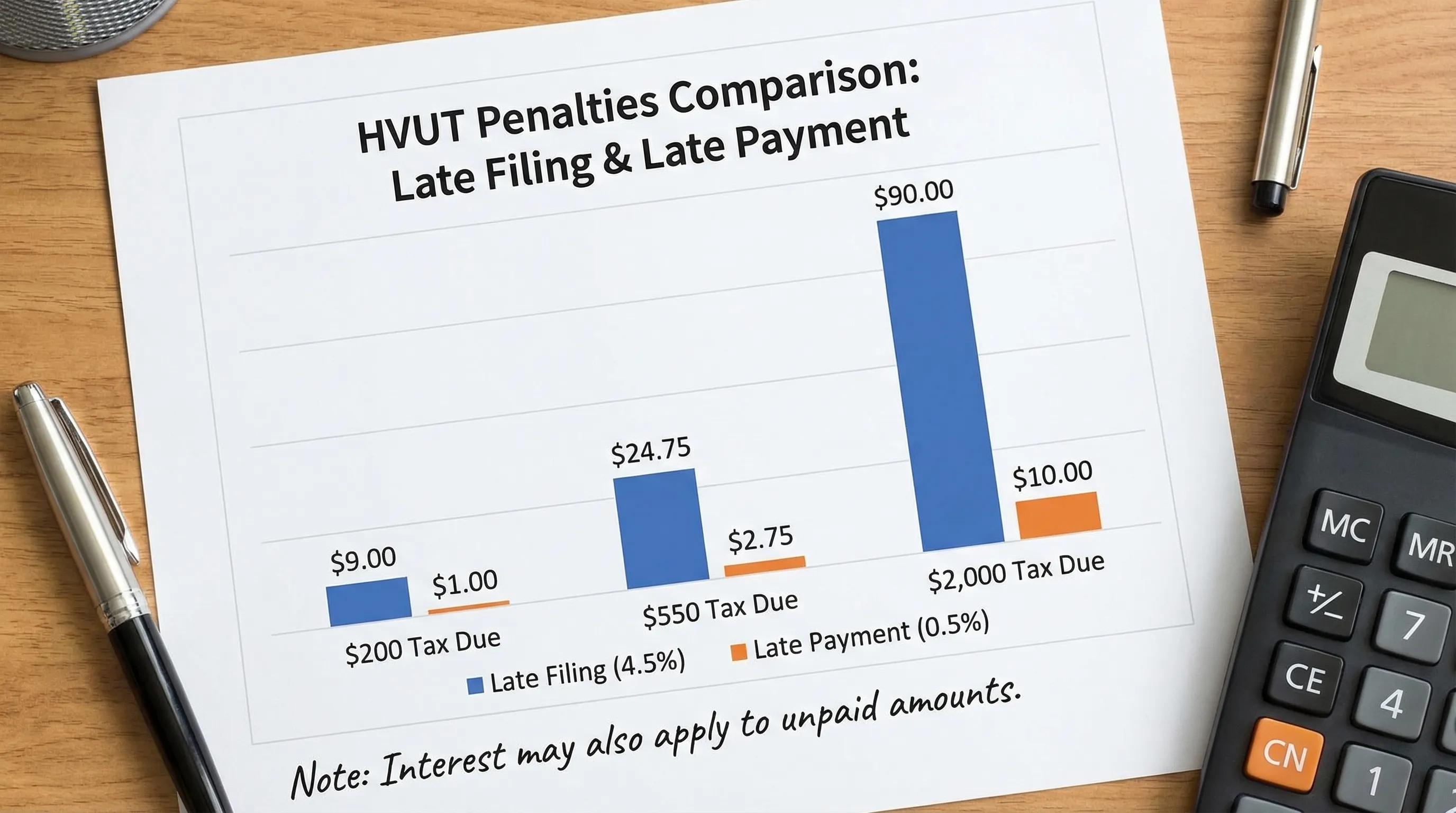
Actionable example: what “one month late” can really cost
Let’s use simple round numbers to illustrate the mechanics.
| HVUT tax due (example) | 1 month late filing (4.5%) | 1 month late payment (0.5%) | Total penalties (interest not included) |
|---|---|---|---|
| $200 | $9.00 | $1.00 | $10.00 |
| $550 | $24.75 | $2.75 | $27.50 |
| $2,000 | $90.00 | $10.00 | $100.00 |
For small operators, $27.50 might feel manageable. For fleets, the bigger risk is multiplied exposure across multiple units, plus administrative drag when IRP renewal hits.
The hidden cost: registration delays, IRP friction, and “truck not moving” days
The penalty itself is only part of the damage. The more expensive impact is often operational.
Most states and IRP jurisdictions require proof of HVUT payment to process registration renewals. If you are missing Schedule 1 because you filed late (or filed but got rejected), you can end up with:
- Plates that cannot be renewed on time
- Trips postponed while compliance is fixed
- Driver downtime and rescheduling costs
If your renewal planning runs through IRP, connect the dots here: IRP truck registration.
This is also why many compliance-forward fleets treat the HVUT cycle like a “must-not-fail” process, similar to insurance renewals or safety audits.
Why late filings happen in 2026: patterns we keep seeing
Even experienced operators get caught. In 2026, the most common drivers behind form 2290 filing penalties tend to look like process issues rather than intentional noncompliance:
1) First-used-month mistakes after equipment changes
If a truck goes back on public roads mid-year, or you add a newly acquired unit, the due date changes. The 2290 form deadline penalty often starts because the team still thinks “we handle 2290 in August.”
2) VIN problems that trigger rejections
A rejected return does not get you a stamped Schedule 1. If the rejection is because the vehicle identification number is off by one character, you might lose days during the most time-sensitive window.
3) Bulk filing complexity for fleets
Fleets are exposed to an “error multiplication” problem: one spreadsheet mapping issue can affect dozens or hundreds of vehicles. If you manage multiple units, lean toward tools built for Bulk and fleet filing instead of forcing a manual process.
Strategy: how to reduce penalty risk
Avoiding the Form 2290 Penalty for Late Filing is mostly about building a lightweight system that makes late filing difficult.
Use a deadline framework that matches how your fleet actually operates
Instead of one annual reminder, use two triggers:
- Annual HVUT cycle: July 1 start, August 31 deadline for July first-use vehicles
- Event-based cycle: “new truck / returned to service / weight change” triggers a new due date
This is especially important if you frequently run amendments, weight category changes, or add units mid-year. For operational context and filing workflow, review form 2290 instructions.
Treat Schedule 1 as your compliance “receipt,” not an afterthought
From a business standpoint, you are not done when you click submit. You are done when your return is accepted and you can retrieve the stamped proof.
If you are filing online, the operational goal is fast acceptance and easy retrieval. Simple Form 2290 is an IRS-authorized e-file platform designed around that workflow, including guided steps, secure data retrieval, and fleet-scale filing support.
To see the filing flow end-to-end, start here: electronic file form 2290 and pay online.
Know when you are required to e-file
The IRS has specific rules for when electronic filing is mandatory (commonly referenced as 25 or more vehicles on a Form 2290 filing). Even when it is not mandatory, e-filing tends to reduce avoidable errors and speeds up Schedule 1 delivery.
You can also compare what to look for in an authorized provider here: IRS Authorized E-file Provider.
Late anyway? Damage control steps that usually matter most
If you already missed the due date, the best “strategy” is speed and accuracy.
- File immediately: every month (or part of a month) can increase the form 2290 late filing penalty exposure.
- Pay as soon as possible: if you cannot pay instantly, still file to reduce the late filing side of the penalty.
- Avoid rejections: double-check EIN and VINs before submitting.
- Document what happened: in some circumstances, taxpayers pursue penalty relief based on reasonable cause (your tax professional can guide you).
If your challenge is simply knowing whether the IRS accepted what you sent, use How to check 2290 filing status.
A quick comparison: paper filing vs e-filing when time is already tight
Paper filing is not “wrong,” but it is a poor fit for time-sensitive compliance.
| Factor | Paper filing | E-filing through an authorized provider |
|---|---|---|
| Proof (Schedule 1) | Often delayed due to mailing and processing | Typically available after IRS acceptance |
| Error handling | Fixes require more back-and-forth | Faster iteration if a return is rejected |
| Fleet scalability | Manual entry and higher admin burden | Bulk workflows and repeatable processes |
This matters because the real business risk is not only the form 2290 penalty itself, it is the time-to-proof that affects registration and dispatch.
Quick answers truck owners ask about late penalties
What is the Form 2290 Penalty for Late Filing?
It is the IRS penalty applied when Form 2290 is filed after the due date, commonly described as a monthly percentage of the tax due, plus potential late payment penalties and interest.
How is the IRS Form 2290 late penalty calculated?
It is typically based on how many months (or parts of months) you are late and the total HVUT tax due, with separate components for late filing, late payment, and interest.
Does the 2290 form deadline penalty apply if I owe $0 (suspended vehicle)?
Penalties are generally tied to filing and payment rules, but even suspended vehicles often still must be reported correctly. If you are unsure, review your vehicle category and filing requirement before assuming you are exempt.
Can I renew IRP registration without a stamped Schedule 1?
In many jurisdictions, no. IRP processing commonly requires proof of HVUT payment, which is why late filing can create operational delays.
What should I do first if I am late to avoid bigger Form 2290 late filing penalties?
File immediately with accurate EIN and VIN details, then pay as soon as possible, to reduce the months counted toward the penalty.
Bottom line
The Form 2290 Penalty for Late Filing is rarely just “a small IRS fee.” It can compound with late payment and interest, and it can create a much larger business problem if it delays Schedule 1 and blocks registration. The most effective fleets treat HVUT as a repeatable compliance process, tied to real operational triggers like first use month, acquisitions, and amendments.
If you want a faster path to filing and acceptance, Simple Form 2290 provides an IRS-authorized e-file workflow built for truck owners and fleets, with guided steps, bulk filing support, and secure retrieval of your stamped Schedule 1 once accepted.
Our services are also available for Pennsylvania, California, Georgia, Florida, North Carolina, Missouri and Colorado.