



05-18-2026
What Is UCR in Trucking? A Complete Guide for Truck Owners
 is in trucking, covering the legal foundation under the Unified Carrier Registration Act of 2005, who must register (for-hire, private, brokers, leasing, exempt interstate carriers), the full 2026 fee schedule from $76 for single-truck operators up to $76,058 for the largest fleets, a four-step application process through ucr.gov, how UCR compares to HVUT, IRP, IFTA, and BOC-3, real-world penalty scenarios up to $1,000 per day, four key 2026 enforcement trends, and how SimpleForm2290 handles the HVUT side of the compliance stack.&p[url]=https://www.simpleform2290.com/blog/what-is-ucr-in-trucking&p[images][0]=https://www.simpleform2290.comhttps://simpleform2290.com/blog_image/What Is UCR in Trucking.png)

What is UCR in trucking? UCR stands for Unified Carrier Registration, a federally mandated annual registration program that requires commercial motor carriers, freight brokers, and leasing companies operating in interstate commerce to register and pay a fee each year.
This program, administered through the FMCSA and participating states, funds highway safety programs across the country. If you haul freight across state lines, understanding the unified carrier registration requirements is not optional, it is a legal obligation. In this guide, we break down exactly what UCR is, who needs it, how much it costs in 2026, and how platforms like SimpleForm2290 help owner-operators stay compliant without the stress.
What Is UCR in Trucking? The Legal Foundation
The Unified Carrier Registration Act of 2005 replaced the older Single State Registration System (SSRS). Under federal law, any motor carrier, broker, or leasing company engaged in interstate commerce must complete their unified carrier registration annually before operating.
The program is jointly managed by the Unified Carrier Registration Plan and the Federal Motor Carrier Safety Administration (FMCSA). Fees collected are distributed to participating states to fund safety enforcement and education programs.
Key facts:
- Applies to carriers operating in more than one state
- Required regardless of whether you own 1 truck or 1,000
- Non-compliance can result in fines, out-of-service orders, and loss of operating authority
Stat to know: As of 2024, over 500,000 carriers register annually under the UCR program, generating approximately $90 million in state safety funding each year. (Source: UCR Plan Annual Report)
Who Must Complete Unified Carrier Registration?
If your operation falls into any of the following categories and crosses state lines, you are required to register:
| Entity Type | UCR Required? |
|---|---|
| For-hire motor carriers | Yes |
| Private motor carriers | Yes |
| Freight brokers | Yes |
| Leasing companies | Yes |
| Exempt carriers (agricultural, etc.) | Yes, if interstate |
| Intrastate only carriers | No |
Many owner-operators are surprised to learn that even a single truck operating across state lines triggers the unified carrier registration FMCSA requirement. The fleet size only affects how much you pay, not whether you must register.
UCR Fee Structure for 2026
The unified carrier registration renewal 2026 fee schedule is based on the number of commercial motor vehicles in your fleet. Here is the current bracket breakdown:
| Fleet Size (CMVs) | 2026 Annual Fee |
|---|---|
| 0 to 2 vehicles | $76 |
| 3 to 5 vehicles | $227 |
| 6 to 20 vehicles | $452 |
| 21 to 100 vehicles | $1,576 |
| 101 to 1,000 vehicles | $7,606 |
| 1,001 or more vehicles | $76,058 |
For most independent owner-operators running one or two trucks, the annual cost is under $100. That is a small price compared to potential fines that can exceed $1,000 per violation.
How to Apply for 2026 Unified Carrier Registration?
Filing your UCR is a straightforward process once you know where to go. Here is a step-by-step overview:
Step 1: Gather Your Information
You will need your USDOT number, FMCSA operating authority (MC number if applicable), and fleet size.
Step 2: Log In to the UCR Portal
The unified carrier registration login is handled through the official UCR system at ucr.gov. First-time users must create an account linked to their USDOT number.
Step 3: Select Your Fleet Size and Pay the Fee
Fees are paid by credit card or electronic check. Once processed, you receive a confirmation that serves as proof of compliance.
Step 4: Renew Every Year
UCR is not a one-time filing. The unified carrier registration renewal 2026 period typically opens in October for the following calendar year. Missing the deadline puts you at risk of operating illegally.
Pro tip: Set a calendar reminder in Q4 each year. Carriers who wait until January often scramble and risk gaps in compliance.
UCR vs. Other Trucking Compliance Requirements
UCR is just one piece of the compliance puzzle. Here is how it fits alongside other common requirements:
| Requirement | Purpose | Filed With |
|---|---|---|
| UCR | Interstate carrier registration | UCR Plan / States |
| HVUT (Form 2290) | Heavy vehicle use tax | IRS |
| IRP | Apportioned license plates | State DMV |
| IFTA | Fuel tax apportionment | Base State |
| BOC-3 | Process agent designation | FMCSA |
A common mistake among new owner-operators is confusing UCR with their IRP truck registration or their annual Form 2290 and IRP registration obligations. These are separate filings with different agencies and different deadlines.
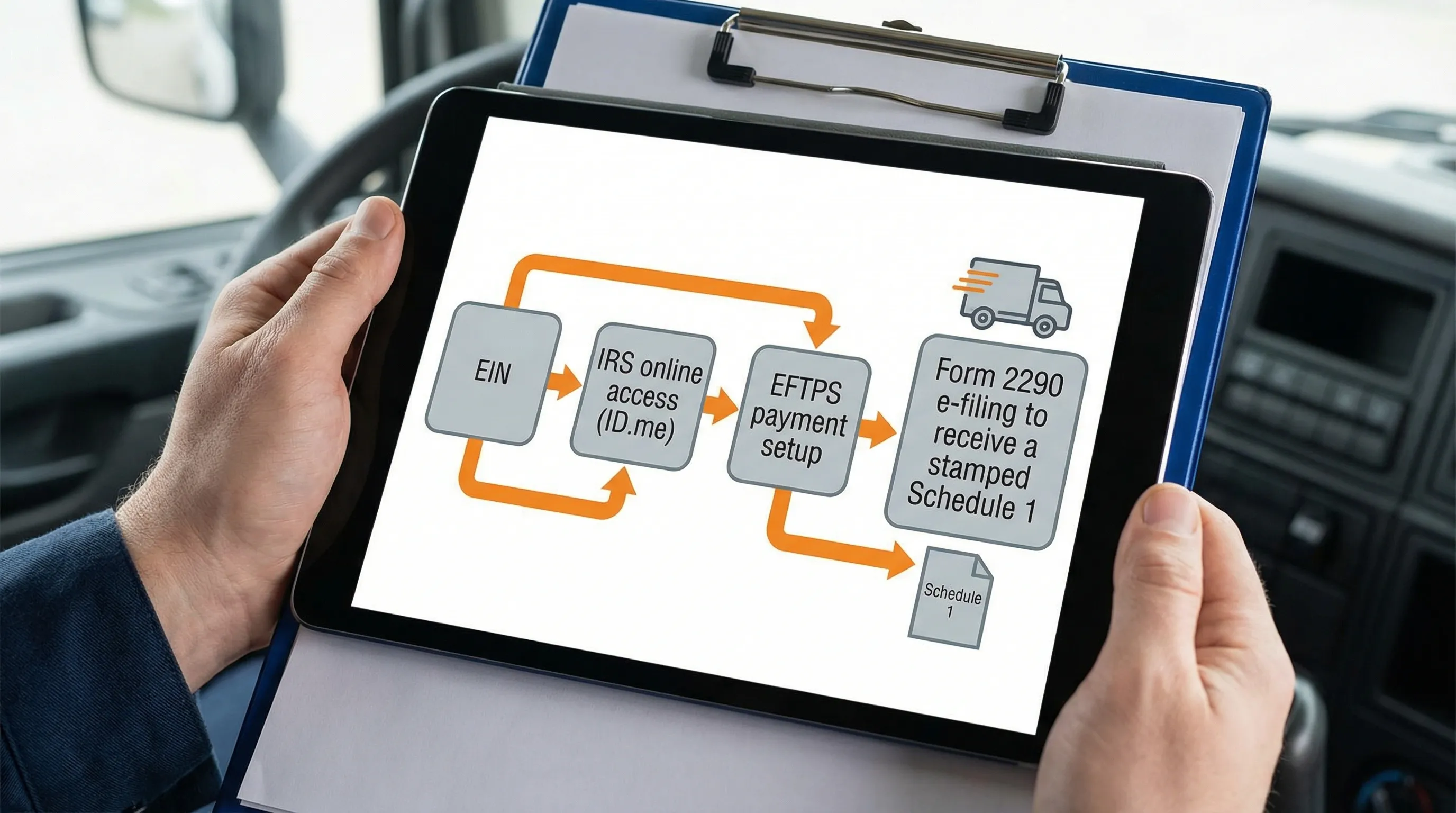
For your HVUT obligations, SimpleForm2290 is an IRS Authorized E-file Provider that makes it easy to electronic file Form 2290 and pay online, receive your Form 2290 Schedule 1 within minutes, and stay road-legal year-round. If you operate a heavy vehicle, understanding your HVUT tax rates by weight and filing accurately matters just as much as your UCR status.
Real-World Scenario: What Happens If You Skip UCR?
Consider a small carrier running two trucks between Texas and Oklahoma. They complete their IFTA and Form 2290 filings every year but forget to apply for 2026 unified carrier registration before the deadline.
During a routine roadside inspection, the officer checks the FMCSA portal and finds no active UCR record. The result: an out-of-service order, a $1,000 fine per truck, and a delay that costs the carrier two days of lost revenue.
This scenario plays out hundreds of times each year. The fix costs less than $100. The mistake costs thousands.
2026 Trends: What Is Changing for UCR?
Several shifts are shaping unified carrier registration in 2026 and beyond:
1. Digital Enforcement Is Increasing
Roadside officers and port inspectors now have real-time access to UCR databases. There is no grace period once you are flagged.
2. Fee Brackets May Tighten
The UCR Plan has been reviewing fee structures to better reflect actual fleet risk. Carriers with 3 to 5 trucks have seen modest fee increases over the past three years.
3. Integration With FMCSA Systems
The unified carrier registration FMCSA integration is becoming tighter, meaning your UCR status is now visible in the same search that reveals your safety rating, inspection history, and operating authority status.
4. Broker Requirements Are Under Scrutiny
Freight brokers who operate without valid UCR face the same penalties as carriers, and FMCSA audits of broker compliance are increasing.
Frequently Asked Questions
1. What is UCR in trucking, and is it the same as my USDOT number?
No. Your USDOT number is a permanent identifier assigned by the FMCSA. UCR is an annual registration and fee program separate from your USDOT registration. You need both to legally operate in interstate commerce.
2. What are the unified carrier registration requirements for owner-operators with one truck?
Any owner-operator crossing state lines must register under UCR, regardless of fleet size. For a single-truck operation, the 2026 fee is approximately $76. You register through the official UCR portal using your USDOT number.
3. When does the unified carrier registration renewal 2026 period open?
The 2026 registration period typically opens in October 2025. Carriers are encouraged to register early, as there can be processing delays closer to the January deadline.
4. What happens if I miss the UCR deadline?
Operating without a valid UCR registration is a federal violation. Penalties include fines of up to $1,000 per day of non-compliance, out-of-service orders, and potential suspension of operating authority. Always renew before January 1 of the registration year.
5. Do freight brokers need to complete unified carrier registration?
Yes. Freight brokers who arrange transportation in interstate commerce are required to register under UCR annually. The fee is based on the broker's classification, not fleet size, since brokers do not operate vehicles directly.
Final Thoughts
Understanding what is UCR in trucking is the first step. Acting on it before the deadline is what keeps your authority intact, your trucks moving, and your business protected.
Between UCR, HVUT, IRP, and IFTA, compliance can feel overwhelming. That is why platforms like SimpleForm2290 exist. Whether you need to apply for EIN as a new carrier, handle bulk and fleet filing for your entire operation, or simply get your 2290 Schedule 1 for IRP processed fast, SimpleForm2290 streamlines the parts of trucking compliance that the road does not wait for.
Stay registered. Stay legal. Keep rolling.
Our services are also available for Form 2290 Texas, Form 2290 California, E-File Florida Form 2290 Online, Form 2290 in Illinois, File Form 2290 in Georgia, File Form 2290 in Tennessee, File Form 2290 in Pennsylvania, File Form 2290 in Ohio, File Form 2290 Online North Carolina, File Form 2290 Online in Indiana, File Form 2290 Online in Michigan, File Form 2290 Online in Arizona, File Form 2290 Online in Missouri, File Form 2290 Online in Virginia and File Form 2290 Online in Colorado.