

01-27-2026
When Is EFTPS Payment Due for Form 2290


Missing an EFTPS cutoff by a few hours can turn a clean Form 2290 filing into a late payment problem, and that can snowball into registration delays when you need your Form 2290 Schedule 1 for IRP truck registration.
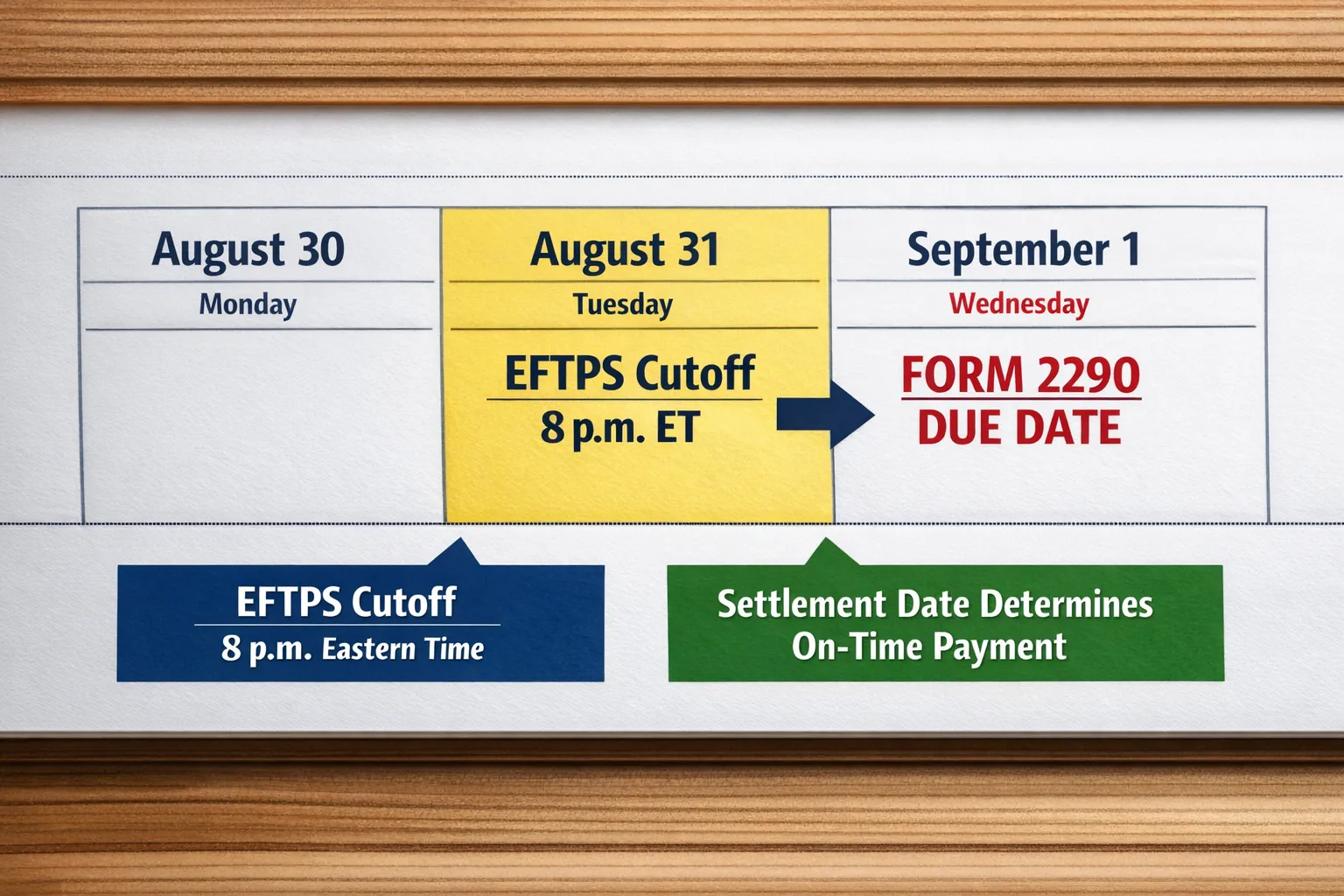
Here’s the rule that matters most: EFTPS payment for Form 2290 is due by the same deadline as your Form 2290 return, but because EFTPS uses a scheduled “settlement date,” you should plan your EFTPS payment at least one business day earlier.
When Is EFTPS Payment Due for Form 2290?
When Is EFTPS Payment Due for Form 2290? The payment is due on the Form 2290 due date, which is generally the last day of the month following the month your vehicle was first used on public highways.
- If your first-used month is July (the most common scenario for annual filings), your Form 2290 filing and payment are due August 31, or the next business day if that date falls on a weekend or federal holiday.
- If you place a vehicle in service later (for example, first use in October), the due date is the last day of the following month (November 30, or the next business day).
The catch with EFTPS is timing.
The EFTPS timing trap: settlement date matters (not “I paid today”)
EFTPS payments are considered on time based on the settlement date you schedule, not simply the moment you log in.
The IRS guidance for EFTPS explains that you must schedule your payment by the EFTPS cutoff time to have it settle on the date you intend. The widely cited cutoff is 8:00 p.m. Eastern Time, the day before the tax due date (confirm on the IRS EFTPS page before peak season). See: IRS EFTPS overview.
Practical takeaway for truckers and fleets
If your Form 2290 is due on a Monday:
- Scheduling EFTPS on Sunday night is too late.
- You generally need to schedule by 8:00 p.m. ET on Sunday to settle Monday (and weekends/holidays can complicate this).
If your Form 2290 is due on a date right after a weekend or holiday, your “safe” scheduling window gets even tighter.
A simple EFTPS deadline chart you can use
This table is a planning tool (not legal advice). Always verify the official due date for your filing period and your bank’s processing rules.
| If Form 2290 is due on… | IRS considers payment on time if EFTPS settlement date is… | Safer EFTPS “schedule by” target (general best practice) |
|---|---|---|
| A normal weekday (Tue to Fri) | That weekday | The prior day before 8:00 p.m. ET |
| A Monday | Monday | The prior Friday (or earlier) to avoid weekend timing risk |
| A date moved due to weekend/holiday | The moved business day | Two business days early during peak season |
Why be conservative? Because HVUT season (late summer) is exactly when fleets are busiest and small timing mistakes cause expensive downtime.
How EFTPS payment timing affects Schedule 1 and IRP registration
Most truckers care about EFTPS timing for one reason: getting a stamped Schedule 1 fast, so they can complete Form 2290 and IRP registration requirements.
In practice:
- Your IRS-stamped Form 2290 Schedule 1 is generated after the IRS accepts your return.
- States and IRP jurisdictions use Schedule 1 as proof you filed HVUT for that VIN and period.
Even if a jurisdiction accepts the stamped Schedule 1 quickly, late payment can still trigger IRS penalties and notices later, which becomes a bigger administrative problem for fleets that want clean compliance records.
Strategic advice: treat HVUT filing + payment + Schedule 1 download as one workflow, not three separate tasks.
If you want a refresher on what Schedule 1 is and why it matters for tags, see this guide: Schedule 1 Form 2290: What You Need to Know.
EFTPS vs other Form 2290 payment methods (which is best for you?)
EFTPS is reliable, but it is not always the fastest option operationally, especially when you are racing an IRP renewal. Here’s a decision-focused comparison.
| Payment method | Best for | Watch-outs |
|---|---|---|
| EFTPS | Fleets that want bank-to-IRS control and standardized accounting | Must enroll ahead of time; must schedule before cutoff; settlement date planning required |
| Direct Debit (ACH) | People who want simple “file and pay” timing | Requires accurate bank details; make sure funds are available on withdrawal date |
| Credit/Debit card | Last-minute payers who need a quick confirmation workflow | Processing fees charged by card processors; can be costly for multi-truck filings |
| Check/Money order (paper) | Rare cases, special handling | Slow, mail risk, slower proof for registration |
Two real-world lessons fleets learn the hard way
Lesson 1: “We filed on time” is not the same as “we paid on time”
A small fleet filing multiple vehicles (bulk filing) may transmit the return early, then plan to “push the EFTPS payment later.” That is a cash flow move, but it adds deadline risk.
The operational cost is usually bigger than the cash benefit. If a truck is down waiting on compliance paperwork for IRP truck registration, one lost load can wipe out the float advantage.
Lesson 2: Small data errors create deadline emergencies
When a filing is rejected or needs correction, you lose time. The most common friction points are:
- Incorrect EIN or business name mismatch
- Wrong vehicle identification number (VIN)
- Wrong first-used month or weight category
If you are using EFTPS, any delay increases the chance you miss the scheduling cutoff.
If VIN accuracy is a concern, this walkthrough can help you avoid rework: How to do VIN Correction for Free.
How to plan EFTPS payment with Form 2290 e-filing (a cleaner workflow)
For most businesses, the smoothest approach is:
- E-file Form 2290 early enough that a rejection does not create a same-day scramble
- Schedule EFTPS payment with a buffer (at least one business day, two during peak season)
- Download and store the stamped 2290 Schedule 1 for IRP as soon as your return is accepted
Using an IRS Authorized E-file Provider helps because you get faster acceptance and immediate access to your filing records, which is crucial when a DMV or IRP office asks for proof.
Simple Form 2290 is an IRS-authorized platform designed for truckers and fleets that want a guided e-file process and fast access to Schedule 1. If you want the broader filing timeline rules (not just EFTPS), this is the most direct reference: Form 2290 Due Dates.

Trend to watch: compliance speed is becoming a competitive advantage
Over the past few years, more fleets have shifted to centralized compliance workflows where HVUT, IRP renewals, and vehicle records are managed together. The IRS rule that you must e-file Form 2290 if you report 25 or more vehicles reinforces that trend toward digital-first compliance.
What this means strategically:
- Fleets with consistent digital records (VIN lists, prior Schedule 1 copies, filing history) recover faster from rejected returns.
- Owner-operators who pre-stage their data avoid peak-season bottlenecks.
If you want a step-by-step view of the e-file process, start here: Form 2290 Instructions.
Frequently Asked Questions
When Is EFTPS Payment Due for Form 2290 if I e-file today? It is due by the Form 2290 deadline for your vehicle’s first-used month (typically the last day of the month after first use). With EFTPS, schedule the payment so the settlement date is on or before the due date, and plan around the 8:00 p.m. ET cutoff the day before.
Can I get my Form 2290 Schedule 1 if I pay with EFTPS? Yes. After the IRS accepts your e-filed return, you can obtain your IRS-stamped Schedule 1, which you may need for IRP registration. Paying on time still matters to avoid IRS penalties and notices.
What if my EFTPS payment posts one day late? You may be subject to IRS late payment penalties and interest, even if your Form 2290 return was accepted on time. If you are close to the deadline, consider scheduling earlier or using a payment option with fewer timing dependencies.
Does my IRP truck registration require Schedule 1 for every vehicle? IRP jurisdictions generally require proof of HVUT filing for heavy vehicles, typically the stamped Schedule 1 that lists each vehicle identification number. Requirements can vary by jurisdiction, so confirm with your state or IRP office.
What information do I need before I e-file Form 2290 and pay online? You typically need your EIN, business name, vehicle identification number (VIN), taxable gross weight category, and first-used month. Having a clean VIN list is especially important for bulk vehicle filings.
File early, pay smart, and avoid IRP delays
If you want to electronic file Form 2290 and pay online without guesswork, Simple Form 2290 helps you e-file through an IRS-authorized process, track acceptance, and download your stamped Form 2290 Schedule 1 for registration.
Get started here: Simple Form 2290. If you are comparing platforms, you can also review what to look for in the Best 2290 E-File Provider workflow (pricing clarity, bulk vehicle filings, secure document storage, and responsive support) before you file.