

02-18-2026
Is TIN the Same as EIN? Key IRS Differences


If you are filing taxes for a trucking business, especially IRS Form 2290 for Heavy Highway Vehicle Use Tax (HVUT), you will hear “TIN” and “EIN” used constantly, sometimes as if they mean the same thing. That is where confusion starts, and it can lead to Form 2290 rejections right when you need your Form 2290 Schedule 1 for registration.
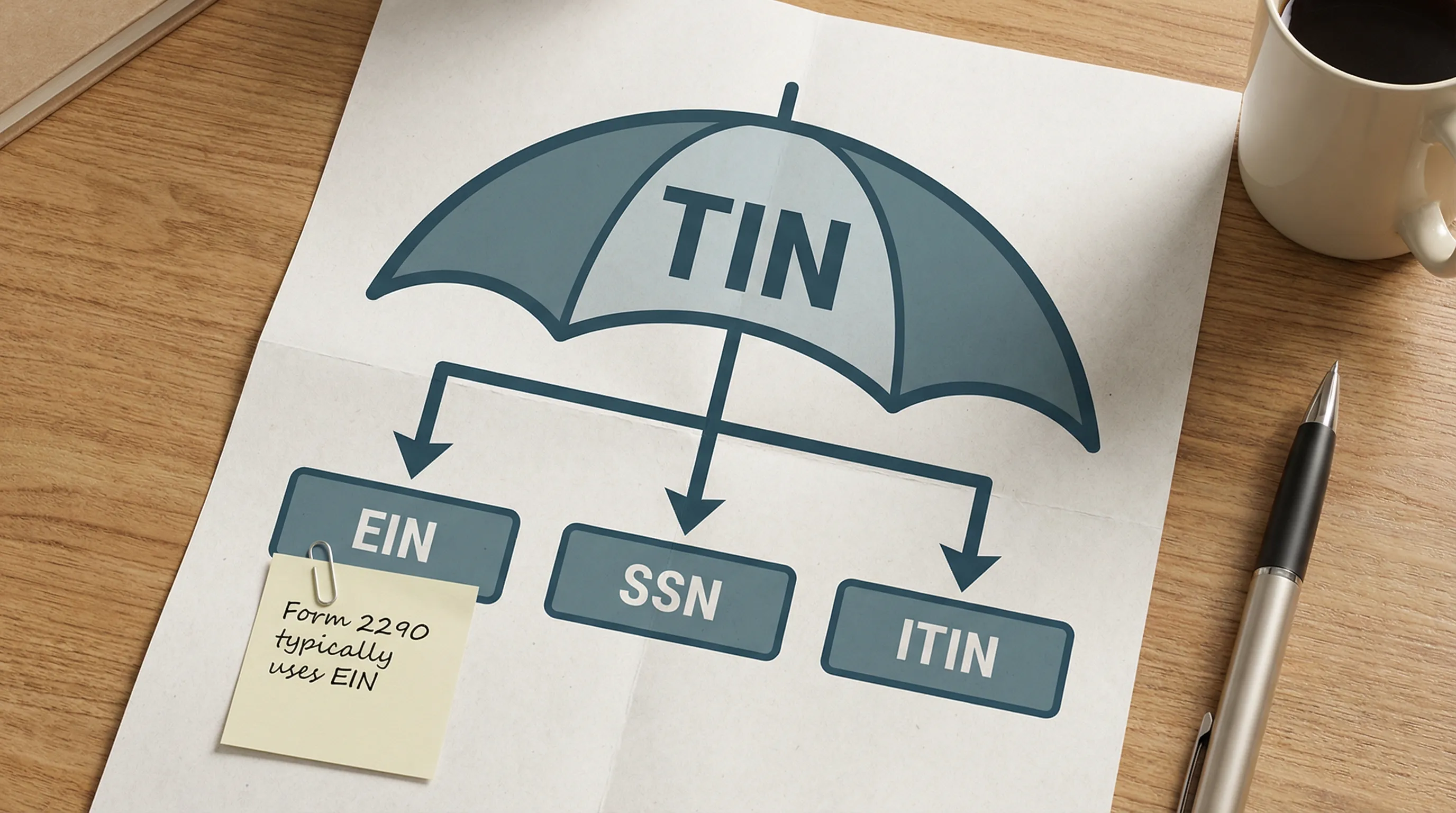
A TIN is a category of tax identification numbers. An EIN is one specific type of TIN. In other words, an EIN can be your TIN, but not every TIN is an EIN.
This guide explains the difference in practical terms, plus what it means for electronic file Form 2290 and pay online, IRP truck registration, and avoiding the most common IRS matching errors.
What is a TIN (Taxpayer Identification Number)?
A Taxpayer Identification Number (TIN) is the general term the IRS uses for the numbers it issues (or recognizes) to identify taxpayers and administer tax laws.
- Individuals may use a TIN like an SSN or ITIN.
- Businesses typically use an EIN.
The IRS uses “TIN” as an umbrella label across forms, notices, and instructions. (See the IRS overview of taxpayer identification numbers.)
Is TIN the same as EIN?
Not exactly.
- TIN = the category (the umbrella term)
- EIN (Employer Identification Number) = one type of TIN (generally for businesses)
So when people ask “Is TIN the same as EIN?”, the accurate answer is: an EIN is a TIN, but a TIN is not always an EIN.
Why people mix them up (and why it matters more in trucking)
On many business tax forms, the field label might say “EIN (or TIN)” or just “TIN” even when the IRS expects an EIN for business filings. In everyday conversation, business owners also say “my TIN” when they really mean “my EIN.”
In trucking, that casual wording can be expensive because Form 2290 requires an EIN for e-filing, even for many owner operators who do not have employees.
The main IRS TIN types (and what they are used for)
Here are the most common tax identification numbers you will see in the U.S. system.
| TIN type | Issued by | Who it’s for | Common use | Example format (not a real number) |
|---|---|---|---|---|
| SSN (Social Security Number) | SSA | U.S. citizens and eligible residents | Individual tax filing, payroll | 123-45-6789 |
| EIN (Employer Identification Number) | IRS | Businesses, partnerships, corporations, many sole proprietors | Business taxes, excise taxes, Form 2290 | 12-3456789 |
| ITIN (Individual Taxpayer Identification Number) | IRS | Individuals who need a U.S. tax ID but cannot get an SSN | Individual tax filing | 9XX-XX-XXXX |
| PTIN (Preparer Tax Identification Number) | IRS | Paid tax return preparers | Identifies the preparer on prepared returns | PXXXXXXXX |
| ATIN (Adoption Taxpayer Identification Number) | IRS | Certain adoptive parents | Temporary ID for a child pending SSN | (varies) |
If you are running a trucking operation as a business (even a single-truck owner operator), the IRS generally expects your business tax identity to be an EIN, not your personal SSN or ITIN.
Which tax ID do you need for Form 2290 (HVUT)?
For IRS Form 2290 (HVUT), the IRS requires an EIN.
You cannot e-file Form 2290 using an SSN or ITIN. The return will be rejected.
You can confirm this in the IRS Form 2290 materials on About Form 2290 and in Form 2290 instructions.
Strategic takeaway: treat EIN readiness like a compliance timeline item
A frequent operational mistake is treating “getting an EIN” as an administrative afterthought. In practice, it is a gating item for:
- Filing and receiving a stamped Form 2290 Schedule 1
- Keeping a registration cycle moving (especially during peak renewal periods)
- Avoiding last-minute workarounds (paper filing, delayed plates, downtime)
If you are new to HVUT filing, see this step-by-step guide on how to apply for an EIN online for Form 2290 filing.
How TIN/EIN accuracy impacts IRP truck registration (and your cash flow)
Many truckers learn the TIN vs EIN difference when they are trying to renew tags or complete Form 2290 and IRP registration. Most jurisdictions require proof of HVUT payment (the stamped Schedule 1) for IRP truck registration.
That creates a chain reaction:
- Incorrect or mismatched EIN, your 2290 is rejected.
- No accepted 2290, no stamped Schedule 1.
- No Schedule 1, IRP processing can stall.
- Stalled registration can mean delayed dispatch, missed loads, and avoidable downtime.
Market reality: small admin errors create “hidden downtime”
In trucking operations, the visible cost is the tax itself. The hidden cost is the operational friction, especially if you are managing a small fleet and wearing multiple hats.
To make this more actionable, here is a simple risk matrix many fleets use internally.
| Issue | Likely outcome | Operational impact | Prevention action |
|---|---|---|---|
| Using SSN/ITIN instead of EIN | IRS e-file rejection | Delay in Schedule 1, delayed IRP | Obtain EIN before filing |
| EIN and legal name mismatch | IRS e-file rejection | Rework filing, deadline pressure | Copy legal name from IRS EIN notice |
| Wrong vehicle identification number (VIN) | IRS reject or incorrect Schedule 1 | Registration problems, amendments | Double-check VIN against title/registration |
| Wrong first used month or taxable gross weight | Incorrect tax and Schedule 1 issues | Amendments, extra processing | Validate inputs before submit |
“I just got my EIN” (why new EINs sometimes cause delays)
Many filers run into a frustrating situation: they receive an EIN confirmation and still cannot successfully e-file immediately.
One common reason is that IRS systems may take time to fully recognize a newly issued EIN across e-file and excise tax databases. This does not mean your EIN is invalid, it often means the IRS record is still updating.
Trend to watch: more verification friction, not less
Across financial and compliance systems, identity matching has become stricter over time (in banking, payroll, and tax filing). HVUT e-filing is no exception. Practically, this means the “close enough” approach to business naming (DBA vs legal name, punctuation changes) is less reliable than it used to be.
Strategic advice: if you are forming a new entity or changing your business structure, plan for identity updates before the HVUT rush.
How to find and verify your EIN (and your “business name”)
To avoid mismatches, use the official source document for your EIN:
- IRS EIN confirmation letter (often called CP 575) or other IRS confirmation notice
When you file Form 2290, the IRS compares your entry to what it has on record. The two most common mismatch issues are:
- Using a “doing business as” (DBA) name instead of the legal name tied to the EIN
- Typing differences (extra punctuation, spacing, “LLC” vs “L.L.C.”)
Best practice: copy the legal business name exactly as it appears on your EIN confirmation.
Common TIN/EIN mistakes that lead to Form 2290 rejection (lessons learned)
Most “TIN problems” are really data quality problems. Here are the patterns that show up repeatedly during filing season.
Using the wrong number type
Some first-time filers assume their SSN is acceptable because they are a sole proprietor. For Form 2290, that is a common (and costly) assumption.
Lesson learned: if you are a sole proprietor, you can still have an EIN, and you generally need it to e-file HVUT.
Transposed digits
EINs are nine digits and easy to mistype. A single swapped digit can trigger a rejection.
Lesson learned: treat EIN and VIN like safety-critical fields. Slow down and verify before submission.
Name mismatch (legal name vs everyday name)
The IRS matching process is strict. If the IRS has “ABC TRUCKING LLC” and you file as “ABC Trucking,” you may see a rejection.
Lesson learned: consistency wins. Use the EIN notice as the source of truth.
Reusing an old EIN incorrectly
If you formed a new entity (for example, moved from sole proprietor to LLC taxed as an S corporation), you may have a different EIN than the one you used years ago.
Lesson learned: align the EIN with the entity that owns and registers the vehicle. This matters for 2290 Schedule 1 for IRP.
Quick guide: Which TIN should you use in common trucking setups?
This table is not legal or tax advice, but it reflects how Form 2290 is typically filed in real-world trucking operations.
| Your situation | What “TIN” usually means for you | What you should file Form 2290 with |
|---|---|---|
| Owner operator, sole proprietor | TIN often refers to your business tax ID | EIN |
| Single-member LLC | TIN may be used generically | EIN (most common for 2290) |
| Partnership | The partnership’s business ID | EIN |
| Corporation (C-Corp or S-Corp) | Corporate tax ID | EIN |
| Fleet under a company name | Company tax ID | EIN |
When in doubt, the safest approach is: use the EIN tied to the entity that will register the vehicle and claim the Schedule 1.
Form 2290 details that get overlooked when you are focused on TIN vs EIN
EIN is only one part of a clean submission. Rejections and delays also come from details that seem minor until you are at the counter trying to finish registration.
- Vehicle identification number (VIN) must match exactly.
- Your taxable gross weight category must be accurate.
- The first used month must reflect when the vehicle first operated on public highways during the tax period.
These items drive what appears on Form 2290 Schedule 1, which is why errors can disrupt Form 2290 and IRP registration.
Paying HVUT: when mailing addresses and payment methods matter
Most truckers prefer to avoid paper filing because it is slower and can delay Schedule 1. But there are still situations where someone mails a return or sends a payment voucher.
If you are mailing Form 2290 with a check or money order, the IRS uses specific locations, and the correct IRS mailing address for payments depends on the type of submission. Using the wrong address can slow processing.
For a trucking-specific breakdown, refer to this guide on the IRS mailing address for Form 2290.
Data snapshot: why e-filing is now the default for time-sensitive compliance
The IRS has been pushing steady modernization through its Inflation Reduction Act funding and technology initiatives. While not specific to Form 2290 alone, the broader trend is clear: digital workflows reduce manual handling and speed up processing.
For trucking operations, the actionable takeaway is simple: if your priority is reducing time-to-proof (getting Schedule 1 in hand), e-filing generally aligns with that operational goal better than paper.
Here is a practical comparison fleets often use.
| Filing approach | Best for | Typical risk profile | What you optimize |
|---|---|---|---|
| E-file through an IRS Authorized E-file Provider | Most fleets and owner operators | Lower clerical risk, faster acceptance cycles | Speed to Schedule 1 |
| Paper filing and mail payment | Limited edge cases | Higher delay risk (mailing, manual processing) | Familiarity, not speed |
The fastest way to avoid TIN-related delays: e-file with an IRS-authorized provider
If your goal is to get a stamped Schedule 1 quickly for registration, e-filing typically reduces delays caused by mailing time, manual errors, and paper processing.
With an IRS Authorized E-file Provider like Simple Form 2290, you can complete an electronic filing workflow and receive your stamped Schedule 1 after IRS acceptance.
If you are comparing options because you want the Best 2290 E-File Provider for your situation, focus on decision criteria that reduce preventable rejections:
- Clear EIN and business-name entry flow (to reduce mismatches)
- Support that can help you interpret IRS rejection codes
- A process designed to help you electronic file Form 2290 and pay online efficiently

Key takeaway
- TIN is not the same as EIN, but an EIN is a type of TIN.
- For Form 2290 (HVUT), the IRS expects an EIN, not an SSN or ITIN.
- Most delays and rejections tied to “TIN problems” come from wrong number type or name and EIN mismatches, not the tax payment itself.
If you want to reduce rejections and avoid delays with Form 2290 Schedule 1, the operationally smart move is to confirm your EIN and legal business name first, then file through an IRS-authorized e-file workflow.